Knocked Off My High Horse
In April I was walking round Madrid when my first shock correlation event hit. Short everything, stopped out. Long everything, stopped out again.
- In April a correlation shock hit every strategy in my book at once. Short on all the assets, stopped out. Long on all the assets, stopped out again.
- Each strategy had been tested hard on its own, then slotted into the book with no risk layer sitting above it.
- What I built after: asset and bucket exposures, news and slippage filters, profit locks, giveback percentages, order splitting, and an open PnL check that runs on every tick.
- My max drawdown is -5.83%. At the time of writing I am -1.17% from my all-time high, and more confident than I was before April.
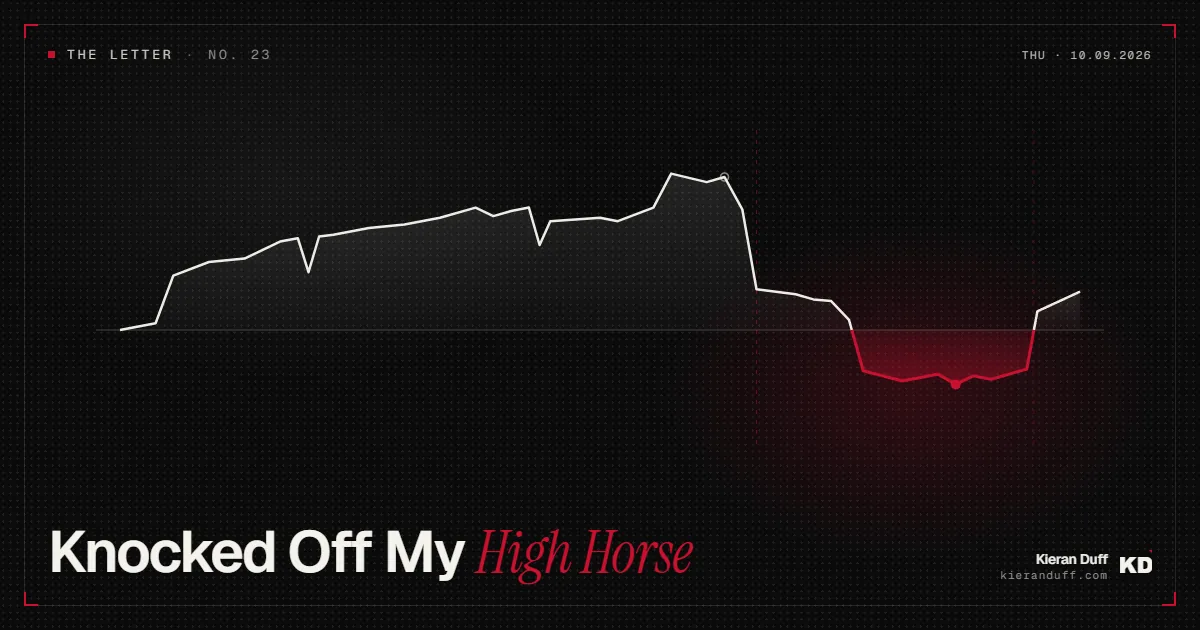
In April I experienced my first shock correlation event. I’d seen these before without realising that I was in them. Every time my book was super concentrated or correlated, I ended up making money, and quite often quite a bit of money, mainly on USDJPY.
What would happen is I would have multiple strategies all firing independently, with no risk management layer on top, no portfolio architecture, and so I was very directionally reliant on that specific market. Nine times out of ten it played out. The reason that it played out nine times out of ten is because each individual strategy that I build has an edge and itself had been put through rigorous testing.
In April I had an experience when Trump released a statement on the Iran war and taking over the Strait of Hormuz. I was walking around in Madrid, visiting the team over in Darwinex with my now wife, and the shock happened. My trade frequency shot through the roof and I ended up getting nailed on gold, dollar yen, and a couple of other assets. The correlation shock happened and my worst fear was realised. I was short on all the assets, got stopped out, went long on all the assets, got stopped out again, and it just really highlighted to me the hidden risk in my portfolio with correlation. That changed everything for me.
I’m somebody who sees a lesson in something like that and actively tries to do something to improve it, and that is exactly what I have done.
The High Horse
My build time before “the shock” was mainly spent on strategies. I would find an idea, I would test a hypothesis, and I would build the final strategy and go ahead and try and break it. It was done on a very individual basis, which worked until it didn’t work. Even now I still have those processes in place but then it gets slotted into the portfolio and I manage correlation in a different way, which I’ll get on to shortly.
I’m a humble person and always have been, but having said that; I was on my high horse. I felt invincible up until this point, again, because everything had worked until it didn’t work. This correlation shock really knocked me off my high horse and made me realise:
“Hey Kieran, you have gaps in your process. There are things that you could improve on and guess what? It’s not the things that you’ve been doing and not the things that you’ve been focused on so far.”
The high horse was just me feeling like I’d beaten the market, because 2025 for me was just a ridiculously easy year to trade. All my strategies worked. All the hidden correlation was on my side and I won every time that it crept up. I’d never really been tested truly before April.
Until You Do It Live
The problem with this and drawdowns in general is that when you’re running a backtest, your backtest is probably going to take minutes, maybe a couple of hours at most, maybe the better part of a day if you’re testing your whole portfolio over a long period of time. Having said that, each individual trade, or each individual position or day during that backtest, takes maybe a few seconds, a couple of minutes tops.
When you’re going through a drawdown, even though the stagnation period may be a week or a few weeks, a month, maybe even a year, you’re only experiencing it in that moment for a brief second. Whereas when you’re in real life, you’re seeing it in real time, you’re experiencing it and living and breathing that drawdown. That occurs over weeks, months, and yes even quarters. That’s when it grinds on you. That’s when you feel the emotion. Even though you see these kinds of things happening in your backtests and your in-sample and out-of-sample periods, you don’t truly appreciate how it feels until you do it live.
My Process Before April
With this in mind my process previous to April was:
- Find a strategy idea.
- Build it.
- Test the hypothesis.
- Try to break it.
- I would just add it to the book if I couldn’t break it.
- Check all the reports when they’re combined.
- Check the final PNL.
- Check the drawdown.
- Of course do some correlation testing and some Monte Carlo testing on the portfolio as a whole.
However my goal was always to maximise upside and to maximise the PNL, never really giving too much thought to correlation and risk.
Whereas now that highlights to me that the process I was missing was really:
Does the book actually need what I’m building? Does this strategy warrant a place in the live book?
Nine times out of ten that answer was probably no. I just didn’t realise at the time.
The Portfolio Architecture
My portfolio architecture is something that I’m really proud of and I spent months building and perfecting. Even now I’m still looking at ways to enhance the architecture because, for me personally, I’m not looking for the highest PNL anymore. I’m not looking to build something that is just a money spinner. I’m looking for something that I can offer out to allocators at serious size with low volatility while still maintaining a positive expectancy over the long run, with a large capacity for AuM. That’s key for me: capacity and volatility, whilst completely separate concepts, go hand in hand. You can’t have high capacity and high AUM with a ridiculously high volatility strategy.
Some of the things that I built in the portfolio architecture are:
- On-Tick checks for stale positions and for open PNL, making sure that my PNL isn’t over what it should be on a down day, which we’ll get into in a moment. I have a real example of why I implemented this and it’s super important to know.
- Bullet in the chamber: why I only set myself one bullet per day, which is counted as a loss.
- Assets and bucket exposures
- News filters
- Profit locks
- Giveback percentages
- Order splitting
- Portfolio-level max lot size
- Spread filters
- Slippage filters
- Regime sizing brain
- And so much more
All of these functions operate separately, but come together to ensure that my portfolio has a “brain” that is constantly monitoring risk, performance and stability. I know that if I go on holiday for 3 weeks, that there’s code monitoring all of the places where my strategies could fail (outside of just a losing trade). Stop doesn’t fire = P&L check, hidden correlation = exposure limits, market crashes = slippage filters block.
The Open PnL Checker
As promised, the story about the open PnL checker.
This idea came to me to build this after I experienced a huge loss in Gold. This is something that runs every tick so it’s constantly happening if I have open positions. I set a number, which is the maximum PnL that I am happy to lose on any specific trade and specific day. PnL doesn’t consider how many trades, the strategy, or anything, only open PnL. If my open PNL exceeds this balance to the downside (this is only negative PnL), it will close the trades and it will block any more positions for that day.
The reason I did this is because I built a gold strategy using StrategyQuant X and I put it onto my testing portfolio book. I woke up in the morning and overnight the strategy had fired a trade. It had tried to calculate the stop based on the stop settings and the money management settings that I’d set in StrategyQuant. It couldn’t build the stop price and therefore didn’t enter a stop price.
I woke up in the morning and was massively, massively offside on that trade and basically gave back everything to the market that that strategy would have made during the backtest period. This means that the strategy, for me, would have been retired anyway based on that alone. It highlighted a bigger issue to me: what happens again in the future if another one of my strategies doesn’t work out the stop correctly? I filled that gap by building this check where it takes a look at my open PnL.
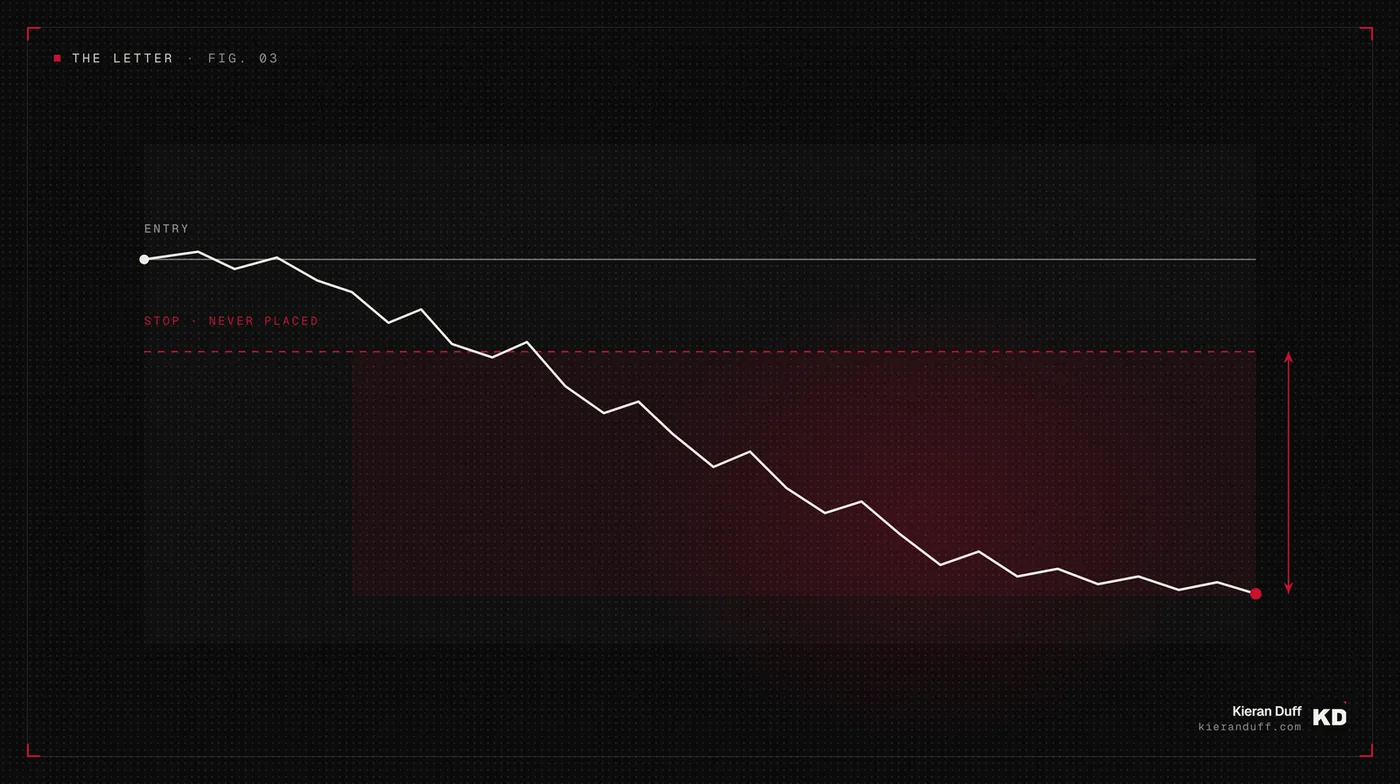
Now luckily for me, I was only running this on my test portfolio, so I survived. It didn’t touch my live book but the important thing here is that it could have been hidden for 3 months, could have been hidden for 6 months. Hell it could have even been hidden for 2 years. The one time where it doesn’t calculate the stop properly would have still bitten me and could have wiped me out on my live book, meaning that I lose my career and my investors lose all their money.
This is a serious, serious problem and it’s one that you don’t realise is an issue until it comes and bites you. I experienced it and I made the fix. However I’m sure there’s a lot of systematic traders out there that haven’t experienced this, haven’t learned that lesson, and haven’t felt what I felt in that moment. Therefore they haven’t made this change on their live books. Super low-hanging fruit to build but truly, truly important.
What It Costs
Now I know you’re all probably thinking: with all these checks, all these filters, and all this risk management that you’ve applied, does this affect your performance and your bottom line? The answer is yes. Any change that you make to your portfolio is always going to affect your bottom line either positively or negatively.
One of the things that I’ve learned over the past 2 years is that my strategies make money long term. Whether you run them separately or you run them as a portfolio, they’re going to make money, because all of them have a small edge. Some of them may decay and some of them may not have edge forever but they all, in their current state, have edge. Therefore I have full confidence that they will make money over time.
However I will happily give back a little of raw return and a little bit of performance to know that I’m safe, to know that my investors are safe, and to know that I fit within a volatility band that I am comfortable with. There are decisions that I’ve made for my own comfortability, such as building strategies that close at the end of the day. I like going into the end of the day with a flat book.
I can’t say that that’s right. I can’t say that it’s wrong. I can’t say that it’s for everybody but for me that’s what works. I’m super comfortable in that position and it means I have less inclination to get involved in positions, less inclination to touch the live book, and less inclination to amend strategies. I’m allowed to perform at my best again. It doesn’t mean it’s right for everybody but that’s right for me.
But the important thing here is to note that, in my opinion, there are sometimes things that are a little bit more important than raw return. Of course if you’re trying to flip an account or maybe trade a funded account and you’re trying to make as much money as you possibly can, raw return may be more important. You’ve got to remember I’m coming at this from the angle of a professional systematic portfolio manager who’s managing a multimillion-dollar portfolio. To me risk is far more important than the reward at this point because I know the reward is coming based on my strategies.
Delayed Gratification
Now don’t get me wrong. All of these amendments and developments that I’ve made to the portfolio, I’ve had to approach with the mindset of delayed gratification. I knew that these changes were for the best but I also knew that I wasn’t going to see the reward for it straight away. I wasn’t, all of a sudden, going to see a new portfolio all-time high purely because I’d restructured the way things work or because I’d added a giveback percentage or this extra filter in the risk management layer.
I knew it was going to take time but after the April shock I realised that I’d rather take my time and hit an all-time high steadily and the right way. My max drawdown is -5.83%. I’m currently, as of the time of writing this, -1.17% away from my all-time high. I have managed to climb back over the past few months and steadily climb my way back near to my portfolio all-time high.
Here’s the kicker: now that we’re back near all-time highs, I have more confidence than I ever have. I have more confidence than I had before the April shock. I have more confidence than I had before I implemented the new portfolio infrastructure. Guess what? I also have more confidence than I did when I was a new systematic trader, when everything was new and I found and thought that I could take on the world.
Still A Work In Progress
The best part about this is that, even though it’s in a place where I feel comfortable, happy, and confident, it is still and forever will be a work in progress. I constantly evaluate my performance on a daily, weekly, monthly, quarterly, and yearly basis. I am always looking for ways to improve. Again improvements to me don’t just mean from a P&L perspective or raw performance. I’m looking for ways to reduce my volatility, increase my risk-adjusted return, increase my CAGR, and increase my Sharpe.
I’m always looking to improve and therefore my portfolio architecture will be something that I will be working on for the rest of my time as a systematic trader. When it’s there it’s going to do all the heavy lifting for you and the strategies are just there to provide signals to your portfolio. It is an efficient machine.
If there’s one thing that you can take away from this piece, it is that you should take a bird’s-eye view of your approach and how you do things and ask:
- Is there a more efficient way to do this?
- Is there a way that I can get better results whilst not giving up too much on the other side?
- Is there a better way to do what I am doing now on a day-to-day basis?
Because this is a career that I’m building for the next 5, 10, 20, 30+ years, I’m going to leave you with one more thing which, as a trader, I think is really really important: stay humble. There’s always somewhere to improve.
Common questions
What is a correlation shock in a systematic portfolio?
A correlation shock is the moment positions that normally behave separately start moving as one, so a book that looks diversified takes every loss at the same time. Mine landed in April 2026, when a statement on Iran and the Strait of Hormuz pushed gold, dollar yen and several other assets in the same direction and my strategies all fired into it.
Do individual stop losses protect you in a correlation shock?
Not on their own. Every strategy in my book stopped out exactly as designed in April. The damage came from all of them stopping out together, because nothing above the strategies was measuring combined exposure or trade frequency across the book.
What is an open PnL check and why run it on every tick?
It is a hard cap on how much unrealised loss the book will carry on a given day. Mine runs on every tick, ignores which strategy is in the trade and how many trades are open, and closes positions and blocks new ones once negative open PnL breaches the number. I built it after a gold strategy fired overnight and failed to attach a stop price at all.
Does a portfolio risk layer cost you performance?
Yes, and I take that trade willingly. Any change you make to a portfolio moves the bottom line one way or the other. I will give back some raw return to sit inside a volatility band I am comfortable handing to allocators, because capacity and volatility go hand in hand. My max drawdown is -5.83%.
I work for Darwinex (FCA-regulated). This is my personal commentary and not advice. Capital at risk.
Disclosure. I work for Darwinex (FCA-regulated). This is my personal commentary, not advice. Capital at risk. I am an employee of Darwinex; content touching Darwinex products may represent a conflict of interest, disclosed per MAR Article 20.
Past performance is not indicative of future results.
Get the next letter in your inbox.
The systematic trading handbook lands in your welcome email, all 24 chapters of it.
Subscribe now