The ChatGPT Contract
I’ve had contracts with a £100,000 penalty for one stray email and infinite damages if the investor lost money. Neither allocator knew what was in them.
- I usually sign between 15% and 20% performance fees. A flat retainer on top is fair when it covers what it actually costs to run the operation: staff, researchers, servers, a salary.
- Capital isn’t the scarce asset. There are plenty of allocators hunting for systematic traders with a verifiable track record, so don’t sign a deal just to sign a deal.
- One agreement let a capital raiser charge me £100,000+ in damages if I ever approached one of their investors, even by accident. Another passed infinite damages to me if the investor lost money.
- Both were almost certainly drafted by AI, and both clauses came out the moment I questioned them. Read your contracts and pay a solicitor to read them too.
The first agreement I ever received was after my first capital landed at Darwinex so I didn’t feel any special kinda way about it because I was already managing investor capital at that point. It felt different because I had had to go and scout myself for a network of allocators and investors and put myself in a position where they would onboard me underneath their fund structure.
As usual, I was at my desk and the message came through. It basically said, “Hey we’re ready to back. The structure is going to be XYZ. It’s going to be in this account under our licence and effectively you’re going to operate as a strategy provider and you’ll earn X amount of fees.”
The Fee Split
The fee split in a professional trading arena does vary and I think it really depends on the amount of AUM that you have, your record, and how much you ask for as well. Allocators are going to be flexible but you have to be very, very careful with that. Usually I will sign a deal between 15% and 20% performance fees; however some do come with additional bonuses.
For full disclaimer here I don’t have a deal where I take a payment outside of raw performance fees. However there are funds that will be creative and will pay retainers or percentages of management fees. You have to be careful with these conversations because if you request too much of a flat retainer up front, it can show that you’re not as confident in your performance and therefore are more happy to give up your performance fees for a flat fee. If you ask for too much it can kind of feel like you’re looking for an easy road to line your pockets.
However I do think it’s okay and wise to ask for a flat fee up front to cover basic costs of you as the strategy operator. Maybe you have staff, maybe you have researchers working on your portfolio. Perhaps you have server costs. Perhaps you need a salary, all of these kinds of things. If you’re onboarding a ticket of $50 million and you’re on 15% performance fees, I think it’s fair and wise as the manager to ask for a reduction in performance fees of 2% to 3% for a retainer of perhaps $5,000 to $10,000 per month. That is fair and that is defensible to an allocator, whereas asking for 5% performance fees and $50,000 a month is just going to get laughed at and will clearly be a no.
Not Every Deal Is A Good Deal
I have taken deals in the past for less than this percentage fee and in part I regret not fighting it as much, because I learned afterwards that capital isn’t the scarce asset. There are so many allocators looking for good managers and specifically systematic traders, of which I am one, and it taught me a lesson: you shouldn’t sign a deal just to sign a deal.
Not every deal is a good deal. It might be for somebody else but not for you.
There’s fine print you need to read. On top of that you have to make sure that you’re not selling your capacity for less than it’s worth.
I know that there’s no other trader out there that is going to have the exact same stream of return that I have. They might have similar, but they won’t have the same because I have single-handedly crafted my strategies and built a portfolio where only I have access to the infrastructure. It’s all custom, it’s all unique. Therefore if you want a piece of that infrastructure, you’re going to have to pay your fair price. I’m not just going to accept low fees just because you want me to. It’s not fair on me as the manager and I would happily walk away from a deal if I feel like I’m being disrespected. You should too.
Read The Fine Print
I’ve also received a few different contracts that clearly have been written via ChatGPT and you, as the manager, absolutely have to safeguard yourself as best as you possibly can.
It’s easy to get excited.
It’s easy to run away with things and to think that you know you’re unlocking the next phase in your life, you’re taking on investors, you’re trading for a fund, then everything is gravy but please, please, please read the fine print.
I have had, on multiple occasions, a contract presented to me for a strategy provider agreement and I’ve checked the fine print. I’ve had to go back to the fund managers and basically say:
“Are you having a laugh? There is no way in hell I’m going to sign this.”
£100,000 In Damages
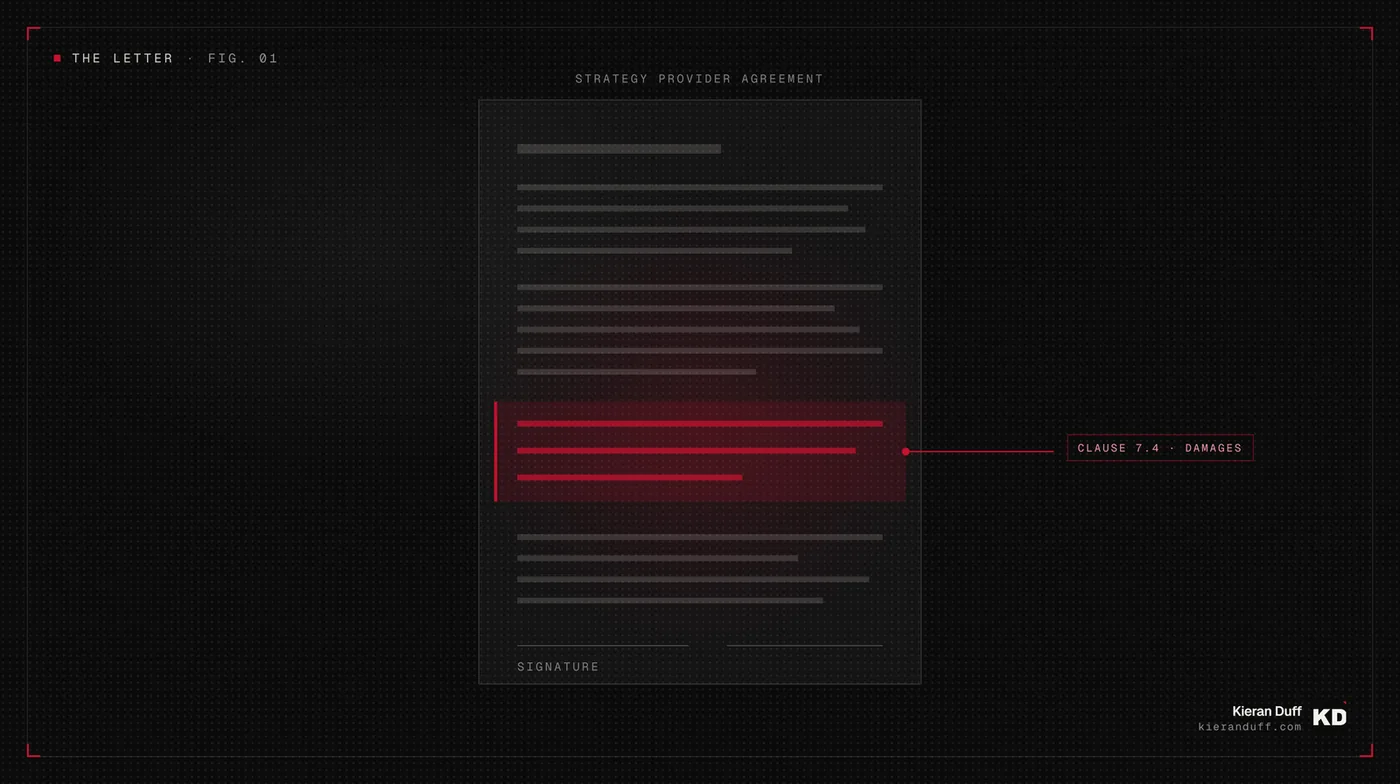
The first example I have is that there was a clause in a contract that I was presented with by a third-party cap raiser. This isn’t even the investor. It’s the person sat in between myself as the manager and the investor and their role is to connect us. They had in the contract with me that if I ever approached any of their investors, even if it was an accident (so if I solicited an email to one of their investors on their list), they could charge me £100,000+ in damages.
I went straight back to the cap raiser and I said, “Listen, you’re crazy if you think I’m signing this.” I work at a firm where we deal with investors, we deal with traders. Odds are our paths are going to cross and our networks are going to align at some point. There is a 0% chance I am ever managing capital for somebody if there is a £100,000 ticket over my head if I step out of line unknowingly. Pure ridiculous. Now the important thing here is that I don’t think that this cap raiser was out to get me because, actually, he’s a friend.
However this highlights something to me that is potentially just as worrying: the contract was probably drafted by ChatGPT. It probably didn’t have a solicitor present or a lawyer overseeing the contract to make sure it was okay and ready to sign off. I don’t think they were even aware of this clause because as soon as I questioned it, it was pulled from the contract and they said, “Okay no problem.” That’s what gives me the inclination that it was an AI that had written it because AI is designed to benefit the person who’s using it. I don’t think it was a predatory approach. However if I had done that and this person had turned against me, they could use that as ammunition to sue me for a lot of money.
Always check the fine print…
Infinite Damages
Another clause I had is for infinite damages to investors and to the allocator (the capital raiser) if I had poor performance and the investor loses money: infinite damages. Let that sink in. I have a period of poor performance and the investor feels hard done by. They end up suing the capital raiser. That capital raiser has full authority on my behalf, as a signature on that contract, to pass all charges over to me and all charges are infinite. They can sue me for as much as they want. No chance. Absolute zero chance. I am putting my name anywhere near a contract like that. And like I say, this is actually a different allocator but I think the message rings true here too. I don’t think they were out to get me. I don’t think they knew that that clause was in their contract but there sure is no way in hell that I’m going to sign anything that reads remotely like that.
Check Your Contracts
Listen, I talk about AI a lot in my writing and in my streams and in my approach generally to the markets. I’m a huge advocate for AI but this is a note to anybody who’s raising capital or anybody who is a manager or a fund manager.
Check your contracts.
Use your eyes to read the contracts that you have drafted. Get a lawyer or a solicitor to read them too. This is a delicate game where real money is at stake and real people’s livelihoods are affected if something goes wrong. You have to make sure that this is a fair transaction for everybody included.
I know it probably sounds like I’m ranting in this piece and to be fair I am a little bit because I think it’s super important and I have never seen an article written about something like this.
Now you go to Jane Street, you go to Citadel, any professional desk. You’re going to have an airtight contract that has a full legal team backing it and you know that you’re going to be protected.
When you’re talking about small boutique funds who probably don’t have the capacity to hire an in-house solicitor or legal counsel, you’re probably going to get a bit of a cowboy contract: something that, like I say, has been built by AI and is trusted because “AI has built it”. There’s still a lot of room for even improvements in this space. Managers are hard to come by and if you treat a good manager poorly, then you have a lot to answer for, because managers are worth their weight in gold, quite literally. You should be screaming out for good managers.
Why Is There So Much Greed In Fund Management?
I’ve had conversations with people who ask you what fees you want. You tell them and they go, “Okay perfect, it’s in the contract.” “I want 15% - cool, 15% it is.” But then I’ve had people negotiate with me and barter me down and ask me to take a lower split because they want a higher split.
Again on the theme of “Managers Are Gold,” you cannot have this relationship without that manager. It’s a lot easier for a manager to find an investor than it is for an investor to find a good manager with a verifiable track record. You should never, ever be bartering down the manager in the relationship. The manager should be paid fairly for what they do because without them nobody is getting a return.
You find a good manager, you raise them as much capital as you possibly can, and you take your fair slice. Of course finders’ fees are absolutely fine and I have them in my contracts and I’m okay with that but don’t take more than you’re worth because you’re the one in that relationship who is easily replaceable. The investor and the manager are the two with anything at stake. The allocator in the middle, the person who’s raising the capital, doesn’t have much at stake other than their reputation.
Remember that because the manager should be fully comfortable with their fees. The investor, of course, should take the lion’s share because they’re the one taking the financial risk but a happy manager will always perform better than an unhappy manager.
Common questions
What performance fee should a systematic trader ask an allocator for?
I usually sign between 15% and 20% performance fees. Where you land depends on your AuM, your record, and what you ask for. A flat retainer on top is defensible when it covers real operating costs: on a $50 million ticket at 15%, giving up 2% to 3% of the performance fee for $5,000 to $10,000 a month is a fair trade. Asking for 5% performance fees and $50,000 a month will get laughed at.
What should you check in a strategy provider agreement?
The damages clauses. I have been handed an agreement letting a capital raiser charge me £100,000 or more if I ever approached one of their investors, even by accident, and another passing infinite damages to me if the investor lost money on poor performance. Both clauses came out of the contract the moment I questioned them.
Are AI-drafted fund contracts a real risk for managers?
Yes. The risk is usually carelessness. AI writes to benefit whoever is holding the prompt, so a contract drafted that way and sent without a solicitor reading it can carry a clause the sender has no idea is in there. Jane Street and Citadel have a legal team behind every agreement. Small boutique funds often run without in-house counsel, so read the contract yourself and pay a solicitor to read it too.
Why should an allocator not barter a manager’s fees down?
Because the relationship does not exist without the manager. It is far easier for a manager to find an investor than for an investor to find a good manager with a verifiable track record. The investor carries the financial risk and should take the lion’s share. The capital raiser in the middle risks their reputation and nothing else, and a happy manager will always perform better than an unhappy one.
Personal commentary, not advice. Capital at risk. I work for Darwinex (FCA-regulated) and this is my own opinion.
Disclosure. I work for Darwinex (FCA-regulated). This is my personal commentary, not advice. Capital at risk. I am an employee of Darwinex; content touching Darwinex products may represent a conflict of interest, disclosed per MAR Article 20.
Nothing here is legal advice. Get a qualified solicitor to review any agreement before you sign it.
Past performance is not indicative of future results.
Get the next letter in your inbox.
The systematic trading handbook lands in your welcome email, all 24 chapters of it.
Subscribe now