Why Your Strategies Fail
Multiple algorithms on one account is ten rogue agents with no manager. The Governor is the desk that manages them, and it is where your alpha actually is.
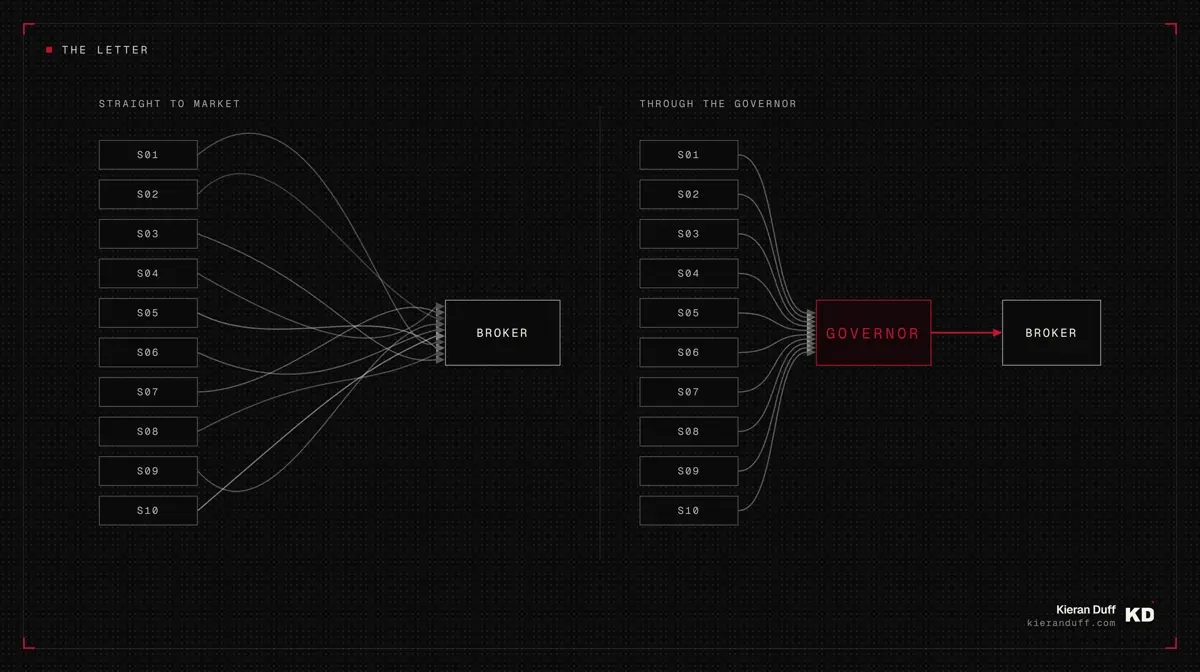
- Ten EAs on one account with nothing above them is ten rogue agents. Each one knows nothing about your total exposure, the market regime, or your P&L for the day.
- The governor is the brain that sits on top. Every strategy fires its trade into it, its agents run their checks, and only then does the order reach the market. Milliseconds, so no lag on entry.
- What the agents watch: entry windows, spread and slippage, order splitting three ways, a calendar for illiquid periods, one bullet in the chamber, profit lock, news filter.
- My favourite is the open P&L check. It reads the book every tick and, if the day is down past a set limit, it cuts the positions and shuts off until the next calendar day.
- 60 to 70% of your development time belongs on the governor. Strategies get built, run, reviewed and rotated; the governor is where the magic happens.
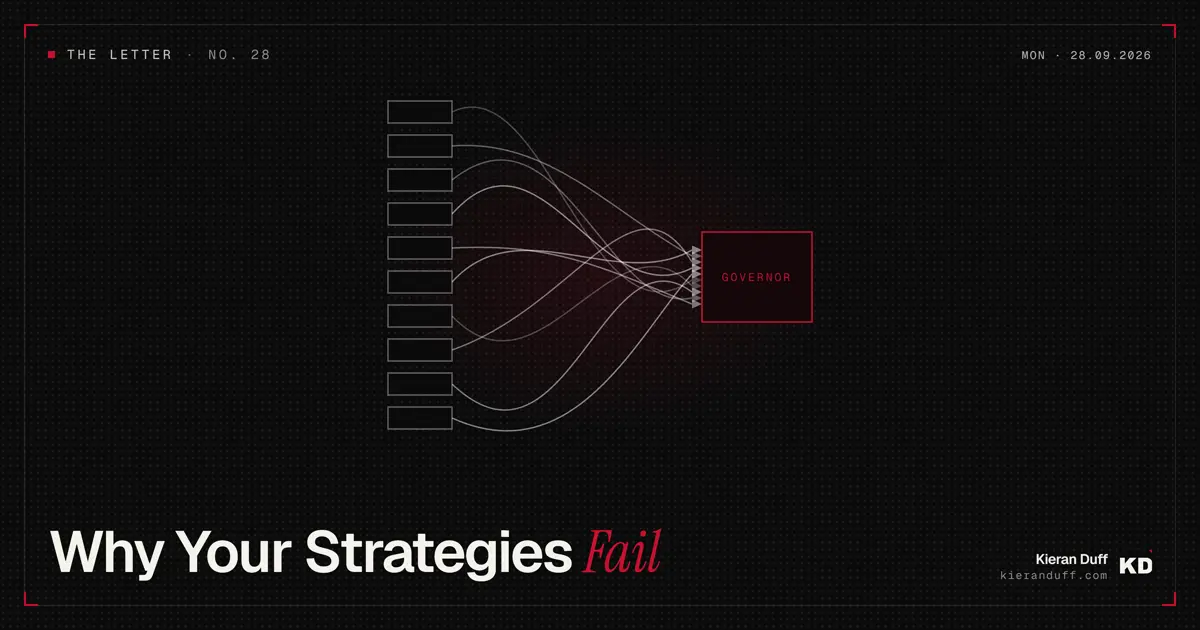
The majority of your strategies fail and die because they are a single organism with their own brain.
They have no idea and no regard for your exposure outside of its own remit. Now this doesn’t seem like an issue at first, because you can still find success with this setup. I’m not disputing that; however it hides a tonne of different issues and has a lot of restrictions on the way that you can run your book, many of which I’ve experienced firsthand.
In short: All you’re essentially doing is running multiple EAs and calling it a portfolio.
There should always, always be a brain sat on top of your strategies. The one thing that stays the same, the one thing that nobody can really replicate, is how you manage those strategies.
Multiple rogue agents all thinking for themselves
For example let’s say I’m running a book of 10 strategies and one of them goes long on gold. It has zero regard or knowledge of how much risk I currently have on the table, the market regime, my P&L for the day, the rules that I’m enforcing outside of that strategy, and so much more. It’s thinking for itself, which is what it’s been exactly designed to do.
The problem here is that you’re combining strategies to run a single portfolio.
Whilst you might have 5, 10, 15 strategies, you’re trying to run one master system, or as I would call it, a book or a portfolio. That portfolio is semi-synthetic, considering there’s actually no portfolio brain or management of the strategies. All you’re essentially doing is running multiple EAs and calling it a portfolio (I did this for a long time). Everything I talk about is from my own experience.
You might not realise it, even for months if not years, but technically what you have is multiple rogue agents all thinking for themselves.
Imagine that in a company. Imagine if Amazon, Google, Microsoft, Tesla, or Meta, any of these companies: imagine every single member of their staff was rogue and didn’t communicate with any other member of staff. They had no managers. There was no direct line. They all just operated with their own sense of free will.
Do you think those companies would survive? I mean they could last for a short period of time, of course, but do you think they would become the top companies in the world? Well I’ll leave that one up to you.
The same goes for your portfolio. There should always, always be a brain sat on top of your strategies. You have to see your strategies as individual managers, or even, taking it a step back further, as your members of staff.
Your alpha is how you manage your portfolio
Your strategies are working for you but I truly, truly believe, and my belief grows week in, week out, that your alpha as your manager is how you manage your portfolio. It’s not the individual strategies. Over time you will rotate strategies, you will bin strategies, you will build more, and you will constantly be developing systems and adding and removing them from the portfolio.
The one thing that stays the same, the one thing that nobody can really replicate, is how you manage those strategies.
What unique things do you place on top so that your strategies that are all firing?
How do you manage them?
How do you manage the exposure?
Are there certain things that you do to benefit the portfolio as opposed to the strategies?
Think of your book as a professional trading desk
I really like the analogy of thinking of your book as a professional trading desk. Imagine a prop desk or a hedge fund.
If you get a job at one of these firms, you’re not going to be sitting in isolation, given capital, and told to go and do your thing. Of course you’re not. You’re going to have many different people around you:
- senior traders
- perhaps a desk manager, somebody who heads up the traders on a specific desk, like the gilts, rates, FX desk, stuff like that
- a risk manager who’s constantly watching your positions and understands the notional risk firm-wide and individual-manager-wide
There are all of these people with one goal: the firm’s success. They have zero regard for the individual manager’s strategy or how the trader makes their money, as long as they’re profitable, of course. What their job is to do is to make sure risk isn’t out of control whilst generating a return. They’re not looking just for the success of the manager. They’re also vowing for the success of the firm.
Now of course, it’s virtually impossible to code a member of staff, right? You can’t code a risk manager who has 20 years’ experience working at a professional proprietary trading firm, managing tens if not hundreds of managers. It’s virtually impossible to do so; however you can code prebuilt rules: if X then Y, if A then B, which is what I have tried to do.
Of course there are drawbacks to it. Generally the more risk limits that you impose, the lower your performance is going to be, but the more stable your curve. There are pros and cons to all of this.
My sole purpose for trading now isn’t to generate the highest return possible. It’s to:
- enjoy my life. I like a calm peaceful life with low volatility.
- make performance fees on performance that I know is going to happen regardless of the risk I take.
I am trying to position myself as a professional manager, not some rookie rogue retail trader who just wants to prove how good I am. I don’t care if I make 10% a year, 20% a year, 30% a year. I don’t care as long as it’s consistent and I can prove that I can recover drawdowns and be sustainable over time at large capacity.
That’s my only goal.
I don’t care if I’m outperformed for a month, a quarter, or a year. Makes no difference to me at all.
Your book is your team
Before I get into some of the checks that I have on my portfolio layer, or the governor, as I call it, if there’s one thing that I want you to take away from this article, it’s to go and think about your book not just as strategies to try and make money but as a professional trading desk run within your PC.
Your book is your team.
Your team needs to be managed. You can only manage the managers, which is the governor. The governor then manages the strategies.
Please go away, turn everything off for an hour, and just use your mind. Think about this. Think about different ways that you can manage your book. Don’t have your screens on, don’t have your notifications on, and don’t have any distractions. Just think about the worst things that have happened to your strategies since you’ve been running them. What could have been implemented to reduce the pain that you felt when things went bad? What could be implemented to manage risk better without damaging returns too much?
The first thing that you have to know here is that we need checks to be running pretty much 24/7 or every tick, if you will.
I have multiple managing agents monitoring the book every tick and yes it takes a bit of power to do that. It’s going to be more intensive on your server than an EA that doesn’t care until it’s in a trade. This is where you need to invest in a better server that’s equipped to run more powerful terminals. Although it’s nothing crazy, it’s just something to be aware of.
I have agents that will monitor entry windows so that I’m not getting entered in illiquid periods. I have agents monitoring spread and slippage. I have agents making sure every position is split three ways using my order splitter. I have a calendar so that we don’t get entered during periods of low liquidity (i.e. over the Christmas break and bank holidays), although I keep bank holidays tradable because generally I have profitable days on them.
I also have a bullet in the chamber, profit lock, news filter. There are so many different agents. Agents will specialise in their own thing and they all work in unison.
Effectively the way that it works is that all the single strategies will fire a trade and they will send it to the governor. The governor then has these different agents that will perform their own checks before sending the order to market. This happens instantly. We’re talking milliseconds so you don’t get any lag on your trade entry.
What it does do is it ensures that every entry that you take is secure and should be there, taking away the need for you to be monitoring your book 24/7 and panicking that something could be going wrong or you have too much risk on the table, etc.
The open P&L check
One of my favourite checks that I have is an open P&L check. The reason this is my favourite is because the agent monitors my open P&L every tick and if my P&L is down by X amount, it will cut the positions and shut off until the next calendar day. I have this max loss set just a little bit larger than what I would expect to lose on a bad day.
The reason that I have this is from my own experience having strategies that have miscalculated stop losses and therefore I’ve had a really bad trade. Also just to know that if I wake up in the morning I haven’t got to panic that some rogue strategy has entered far too much size or hasn’t miscalculated a stop, or I haven’t got in multiple positions and been stuck out (because my open P&L checker is constantly working as long as my server is online). It’s constantly working, meaning that my risk is always covered. You are effectively looking at ways to cover your back when you’re not able to monitor the situation first-hand.
Then you have the situation of what happens when your book is in a trade.
You now have a position open, there’s risk on the table, and you’re either going to win or lose. How does the governor manage that? Again there are a few different ways and too many things that I have to put into one article.
One of the more important things that I have is something I’ve learned from experience: you can’t always trust what you’ve built from a strategy perspective, if you’ve put to close at the end of every day but then the market closes early because of a bank holiday, for example. Your position doesn’t close and it can get stuck in this loop where that position will stay open forever because it hasn’t met the criteria to close the trade.
I built a stale position checker and that runs every tick but only every tick where there’s a position open. Essentially what it does at its core is, if there’s a position open, it will check the original logic of the trade: why are we in this position? It will check every tick: should we still be in this trade? It’s very simple: yes or no.
As soon as that says no, it will close the position. Super useful. It means that you don’t have any rogue trades being overextended where they should be. If you should be out of the position, you need to be out of the position.
I turn those experiences into lessons
If you were to ask me what my governor would look like in a year’s time, honestly I don’t know, because the way that I operate is I have experiences.
I turn those experiences into lessons and then I turn those lessons into implementation.
I will go away, and I will take what I’ve learned and I will build things to ensure that my back is covered from those moving forward.
The key point to this whole article is that I truly believe 60 to 70% of your development time should be built on developing the governor, refining the governor, and monitoring the governor, as opposed to the strategies. The strategies can generally be something that you build once, you run it for a few months, you review, perhaps you change some small things, but the governor is where the magic happens.
The portfolio or the book of law is your alpha and it’s important that you treat it as such.
As always, thank you for reading. I hope you find some value in this.
Common questions
What is a portfolio governor?
A layer of code that sits above every strategy in the book. Strategies fire their trades into the governor, its agents run their checks, and only then does the order reach the market. It takes milliseconds, so there is no lag on entry. Without one you are running multiple EAs and calling it a portfolio: each strategy knows nothing about your total exposure, the market regime, or your P&L for the day.
What checks should a portfolio governor run?
Entry windows, so you are not filled in illiquid periods. Spread and slippage. Order splitting, three ways on every position. A calendar that blocks entries over the Christmas break and the illiquid holiday stretches. One bullet in the chamber, profit lock and a news filter. Each agent specialises in one thing and they all run in unison, every tick, which is more demanding on your server than an EA that does nothing until it is in a trade.
What is an open P&L check?
An agent that monitors open P&L every tick and, if the day is down by more than a set amount, cuts the positions and shuts the book off until the next calendar day. The limit sits a little above what I would expect to lose on a bad day. It exists because I have had strategies miscalculate a stop loss, and it means the risk is covered while I am asleep, without depending on me being at the screen.
What is a stale position checker?
An agent that runs every tick while a position is open and re-checks the original logic of the trade: why are we in this position, and should we still be in it? Yes or no. The moment the answer is no, it closes the position. It exists because a strategy set to close at the end of the day will not close if the market shuts early for a bank holiday, and the position can then sit open indefinitely because it never meets its exit criteria.
How much development time should go on the portfolio layer versus the strategies?
60 to 70% on the governor. A strategy is largely build once, run it for a few months, review, adjust a little. You will rotate strategies, bin strategies and build more. The governor is the part nobody can replicate, and it is where the alpha in a systematic book actually sits.
Personal commentary, not advice. Capital at risk. I work for Darwinex (FCA-regulated) and this is my own opinion.
Disclosure. I work for Darwinex (FCA-regulated). This is my personal commentary, not advice. Capital at risk. I am an employee of Darwinex; content touching Darwinex products may represent a conflict of interest, disclosed per MAR Article 20.
The risk controls described here are the ones I run on my own book. This is a description of my process. Nothing here is a recommendation, and no set of limits removes the risk of loss.
Past performance is not indicative of future results.
Get the next letter in your inbox.
The systematic trading handbook lands in your welcome email, all 24 chapters of it.
Subscribe now