I’m the #1 Trader in the UK
Top of the UK table on annualised return, around seventh on absolute return, and the 7 or 8 years of discretionary trading that came before either.
- Filter the Darwinex Zero community leaderboard to UK traders whose DARWINs sit in the INDX master fund and XAQP is first on annualised return, with the smallest max drawdown in the table. On absolute return I sit around seventh.
- Annualised return levels the playing field. Traders with 5 and 10 year records will always beat me on absolute return because they have had years longer to compound.
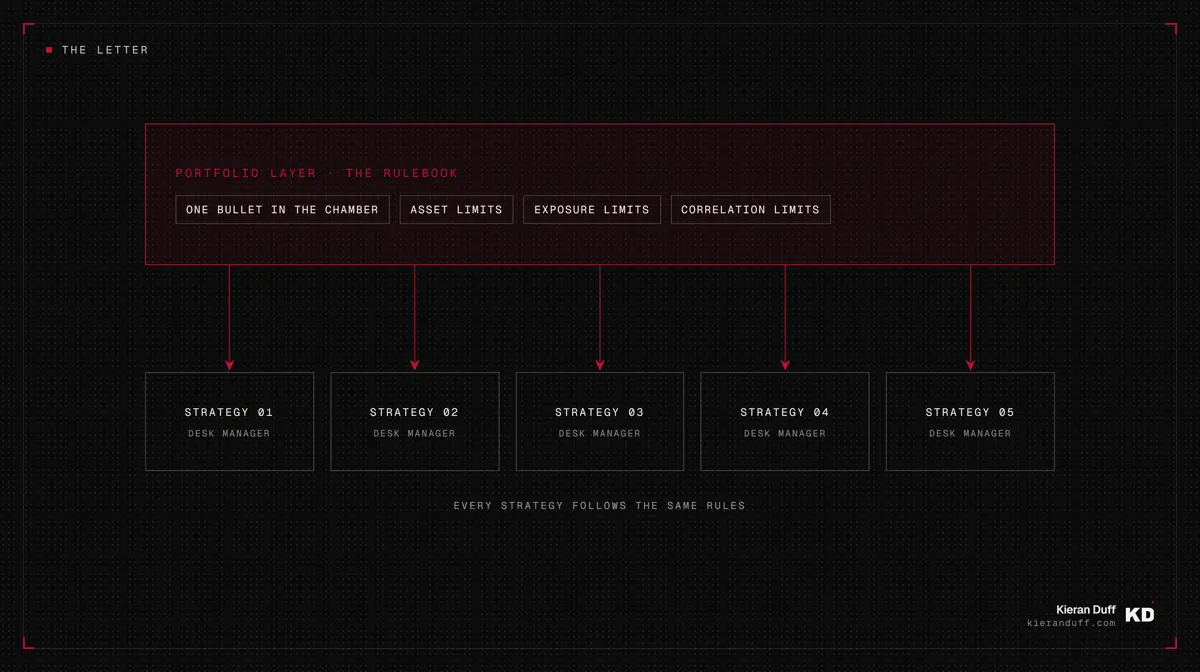
- The tail-risk question allocators ask: one bullet in the chamber, asset limits, exposure limits, correlation limits, and no negatively skewed strategies anywhere in the book.
- The portfolio governance layer was the biggest development of my systematic career. Imagine your codebase as a trading floor and the layer as the rules every desk has to follow.
- I would never say “number one” in an allocator meeting. It’s a high pedestal to fall from, and they buy into you as a person long before they buy the numbers.
Listen, I dragged you in with a little bit of a clickbait title. However there is a real achievement here.
Number One Trader in the UK
Yesterday I took a look at all of the top DARWINs who are included in the INDX at both Darwinex and Darwinex Zero. If you filter to only show traders who are included in the master fund (INDX) - you are already filtering out 99% of traders to only show the top-calibre talent that we have at Darwinex. In the UK I am number one when it comes to annualised return. Number one.
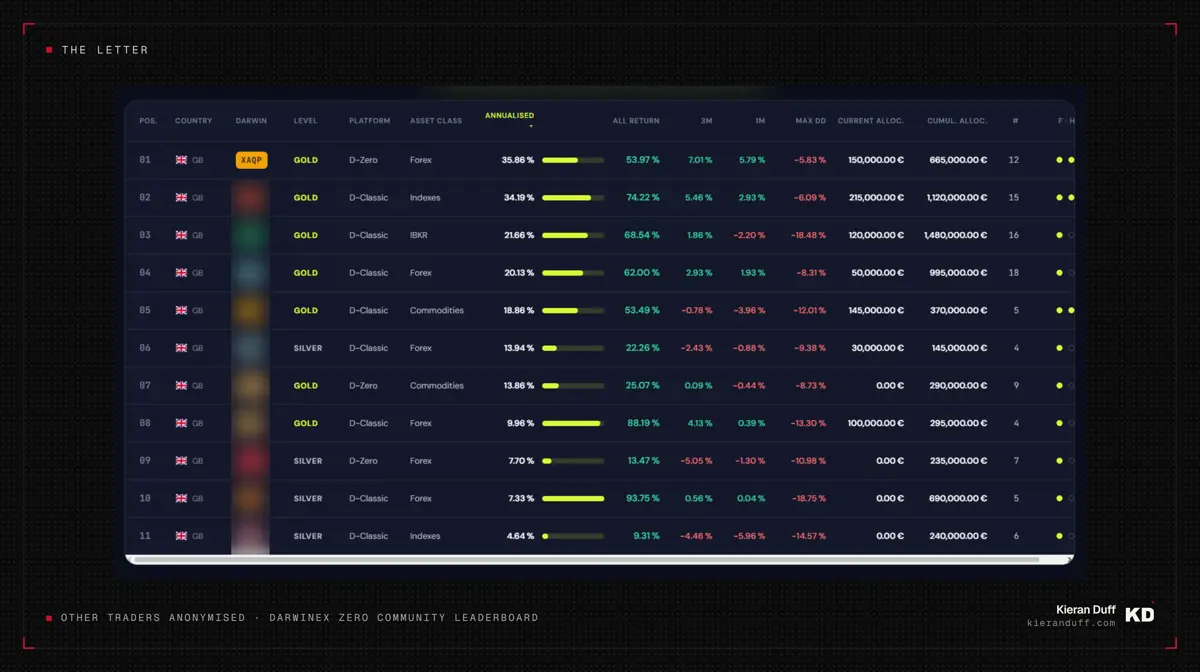
This ranking specifically lives in a Darwinex Zero community leaderboard that we have, where you can filter DARWINs down by location, skill level, assets traded, all of this sort of stuff. Like I say, for this example I was only looking at UK-based traders.
The thing is, if we sort the list by actual return, I sit around seventh but that’s comparing XAQP to traders with track records of 3, 4, 5+ years. It’s an unfair metric to judge, as older traders will generally always have record-length bias on their side. If you filter it by annualised return or even by max drawdown I’m the number one trader in the UK at Darwinex. My max drawdown is the smallest out of any trader included in INDX from the UK and my annualised return so far, is higher than any other trader in the UK.
I’m not naive enough to think that this can change and probably will change over time. I have performed extremely well since running XAQP and perhaps in the future I might have a quarter or a year, even, where I probably underperform. It’s important to know that, and appreciate the fact that that can happen. As I always say, I’m humbled but never satisfied.
Okay, humble brag out of the way now let’s get into it.
Why I’m looking at annualised return
The reason that I’m looking at annualised return is because I wanted to level the playing field. There are traders with 10+ years of experience on Darwinex. I can’t compete with them on an absolute return basis and therefore it’s important to also consider the annualised return.
To rank so highly with that, to me personally, at such an early stage in my systematic trading journey, is a massive achievement. I am super, super humbled and quite sentimental about it, because I sink a lot of time, energy and effort into developing as a manager, even now and then writing about it for everybody here.
A lot of my focus goes into stable returns as opposed to trying to make as much return as possible within a limited amount of risk. I respect risk so much and therefore I try and manage my volatility intraday far more than most of the traders that I know.
What is the hidden tail risk, if any?
This does come with a caveat. Some speculation from allocators is that there’s heavy tail risk on the portfolio. It sort of looks to a degree like a martingale curve because, realistically, it’s never been truly tested from a drawdown depth perspective although drawdown duration certainly has been.
The question that gets asked of me here is: what is the hidden tail risk, if any? At the moment the curve is incredible. So my honest answer is that I have so many features built in and active: the one-bullet-in-the-chamber, asset limits, exposure limits, correlation limits, all of these things block the extended tail risk. I don’t have any negatively skewed strategies. The minimum that they go to is a 1:1 risk-to-reward from a pure math perspective. A lot of them do have lower average winners and lower average losers because they close at the end of the day.
Not a single strategy has, on its own, large tail risk. The portfolio governance layer adds a second layer to that because there are so many risk limits in place so there isn’t any hidden tail risk on the portfolio, at least not as far as risk management and strategies are concerned.
Whilst we’re talking about allocators, saying that I’m number one is probably not something that I would ever actually mention to an allocator in a direct meeting, purely because it’s a high pedestal to fall from. The allocator generally makes a decision based on you as an individual and less about your numbers, because, as I’ve mentioned in the past, a quote from Cláudia Quintela is: “Performance gets you in the door but the allocator really buys into you as a person”. If you go in there and you start bragging and talking about being the best and the number one, they might give you a chance but guess what they’re going to expect? A star performance 24/7. It’s a tough bar to set at the beginning and a high pedestal that you can fall from.
I was a discretionary trader for 7 or 8 years
Now I want to roll it back slightly to before I entered the world of systematic trading.
I was a discretionary trader for roughly 7 or 8 years before becoming a systematic trader. That included spats of trading in crypto, FX, and decentralised finance, which I guess is a crossover with crypto, and I had varied results. I had very, very good years and I also had very, very bad years. It probably averaged out to be an “okay” trader. I wasn’t amazing and I wasn’t awful.
I realised over years that, for me, it wasn’t something that I wanted to be doing long-term. I didn’t like the pressure whilst raising a young family because I was finding that, P&L aside, it doesn’t matter whether it was a good day or a bad day, it would have so much weight on my mental state. When I’d go downstairs to my children, I’d find that I was still holding stress from the day and it was weighing me down.
This is the biggest thing that becoming an algorithmic trader solved for me: my decisions are preplanned. I don’t feel any type of way about a decision in the moment because there’s no emotion or bias kicking in to make me take a trade or not take a trade. It’s all predefined.
I then interviewed a friend of mine at the end of 2024 who had also made this shift probably about a year and a half before I did. After seeing their performance it got me thinking about my career and my life as a trader. Ultimately I went away and figured some things out and very, very quickly I decided that systematic trading was the way for me.
The April shock
I had an amazing start to my systematic trading journey. A little bit of luck sprinkled in there perhaps, and I know that now. I had a fantastic run for about a year and scaled very quickly. Performance metrics were off the charts and then I went into my April drawdown.
I had hidden correlation. I hadn’t really thought about this at the time so I didn’t know it was a hidden risk, which got me thinking about the next glass ceiling that I had to break through. Now I had all these skills. I knew how to build strategies and I knew how to stress test them but now I needed to figure out: how do I operate as a professional portfolio manager?
At that point I was just a systematic trader. Now I need to become a systematic portfolio manager. I need to understand that when investors are giving me capital to manage, I had a responsibility to safeguard them in proactive ways for risks that I couldn’t foresee coming.
For example we never know when Donald Trump is going to tweet something about the Strait of Hormuz. We never know when there’s going to be a war kicking off. We never know when the market is going to plunge because a $50 billion company has gone into administration. We don’t know these things ahead of time but what we can do is put safeguards in place.
Imagine your codebase to be a trading floor
That brought me onto my portfolio layer, which has been the biggest development in the whole of my systematic career thus far. I highly, highly recommend every single person to put as much time as possible into building a portfolio layer, a governance layer, if you will, looking at different elements of risk as a layer above your strategies. They are your risk manager, your desk manager, your trade analyst, your macro analyst. They are everything combined into one piece of code that manages the strategies.
Think about it like this: imagine your codebase to be a trading floor. You have all of your managers, which are each individual strategies. Each of them does their own little thing but you, as the firm, must manage them in certain ways. That’s what the portfolio layer does: it’s rules that are prewritten that every manager should follow, that every strategy has to follow, and it’s a super efficient way of building something professional.
Should an achievement like this be the right goal for you?
At this point I want you to think about your long-term goals as a trader. Should an achievement like this be the right goal for you? I would say probably not.
Don’t focus on becoming the best. Don’t focus on ranking on a leaderboard. Let it happen naturally. Do everything that you can to improve all of your weak spots. Put your foot down on the gas when it comes to development: finding your weak spots, brutalising your strategies, and finding ways to improve.
Don’t focus on other people or things that you can achieve because that will all come naturally in time anyway. Time is on your side. Never forget that time is always on your side in trading.
I don’t expect to be number one forever
Listen I don’t expect to be number one forever. I don’t expect to be in the top ten forever. We have good periods, we have bad periods. Look at a UFC champion: they’re the best in the world for a short period of time, usually. Does it take away from their achievements when they lose the title to a much younger hungrier fighter who has a different set of skills to them? Of course not. There are champions who stick in your mind because of what they achieved when they were at the top and that’s exactly what this piece is about.
At the moment I feel on top of my game and my way of celebrating that is to share that with all of you, the people who read my work on a weekly basis. As you all know I’m honest about my growth. I don’t pull any punches. There’s no reason for me to lie. My performance is out there. You can all view it as and when you want. You can scrutinise me whenever and that won’t ever stop me from turning up, from writing articles, and from trying to bring as much value as is in my head to anybody who’s reading this.
I truly appreciate every single one of you. Have a fantastic rest of your week, enjoy your weekend, and I’ll catch you again on Monday.
Common questions
What does being number one on the Darwinex Zero leaderboard actually measure?
It is the Darwinex Zero community leaderboard, filtered first to DARWINs included in the INDX master fund and then to UK-based traders. INDX inclusion on its own screens out around 99% of traders. Sorted by annualised return, XAQP is first in the UK. Sorted by max drawdown, mine is the smallest of any UK trader in INDX. Sorted by absolute return I sit around seventh, because that metric rewards track-record length.
Why rank on annualised return instead of absolute return?
Absolute return carries record-length bias. There are traders on Darwinex with 10+ years behind them and I cannot compete with a decade of compounding, so comparing absolute return compares elapsed time as much as it compares skill. Annualised return levels the playing field. It is not a permanent position either. I expect a quarter or a year where I underperform, and I would sooner say that upfront.
Is there hidden tail risk in the XAQP curve?
That is the question allocators ask, and the honest answer is that the curve has never been truly tested for drawdown depth, although duration has. What sits underneath it: one bullet in the chamber, asset limits, exposure limits and correlation limits, all enforced at the portfolio layer. None of the strategies are negatively skewed and the worst risk to reward on any of them is 1:1 on the maths. No single strategy carries large tail risk on its own, and the governance layer adds a second set of limits on top of that.
What is a portfolio governance layer?
A layer of code that sits above your strategies and enforces the same rules on all of them. Imagine your codebase as a trading floor: each strategy is a manager doing its own thing, and the governance layer is the risk manager, the desk manager, the trade analyst and the macro analyst combined into one piece of code. Asset limits, exposure limits, correlation limits, one bullet in the chamber. It has been the biggest development of my systematic career so far and I would tell anyone to put as much time into it as they can.
Personal commentary, not advice. Capital at risk. I work for Darwinex (FCA-regulated) and this is my own opinion.
Disclosure. I work for Darwinex (FCA-regulated). This is my personal commentary, not advice. Capital at risk. I am an employee of Darwinex; content touching Darwinex products, Darwinex Zero and its community leaderboard included, may represent a conflict of interest, disclosed per MAR Article 20.
The ranking described here is a snapshot of the Darwinex Zero community leaderboard taken on 23 September 2026, filtered to UK-based DARWINs included in the INDX master fund. It is one filtered view of one community leaderboard and it moves as records lengthen. Other traders in the screenshot are anonymised. Figures are since inception, before fees (gross), and past performance is no guide to what comes next.
Past performance is not indicative of future results.
Get the next letter in your inbox.
The systematic trading handbook lands in your welcome email, all 24 chapters of it.
Subscribe now