Is It Scalable At Least Until 250M?
A real conversation about a $250M mandate, and why staying ahead of the questions shows a manager who’s ready to back.
- The screening questions are short and blunt: Sharpe, instruments, the strategy in a sentence, then capacity. Everything sophisticated about due diligence happens after you answer these questions.
- Every number you show has to be labelled gross or net, simulated or live, master account or risk-adjusted. Allocators are more bothered about net, gross is irrelevant to them.
- I volunteered that my Sharpe ratio is flattered by one strong year and will settle lower. Honesty costs me nothing and it is the reason the rest of my numbers get believed.
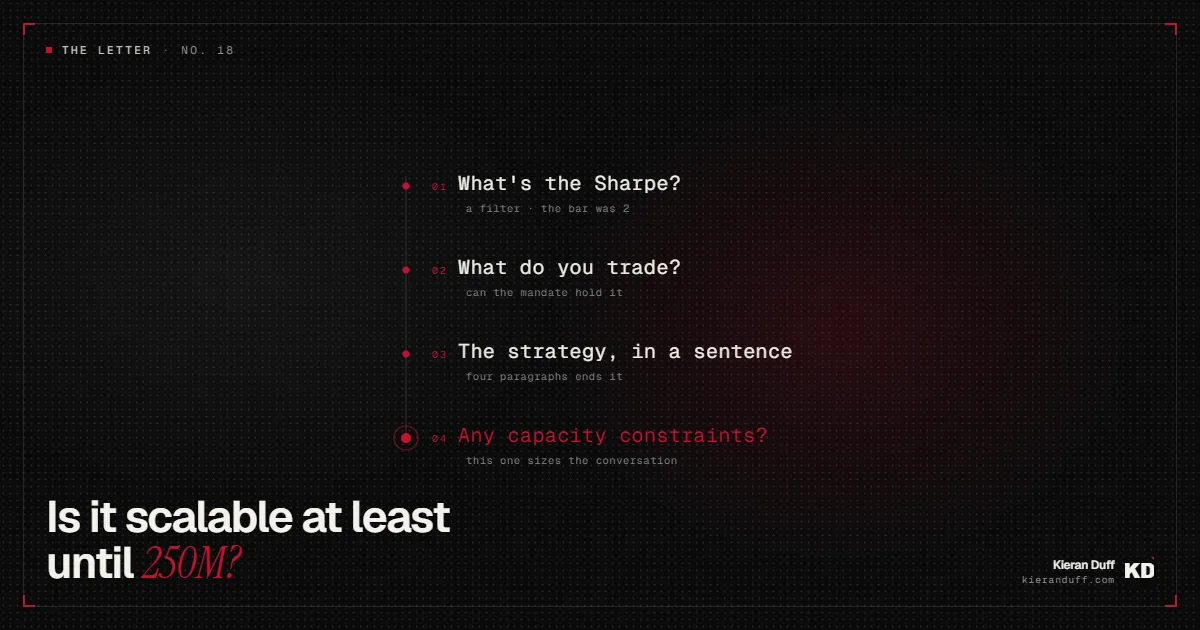
An introducer put three questions to me this month, in this order: what is your Sharpe, what do you trade, and what is the strategy in a nutshell? That is what allocators look for in a systematic trading strategy. He did not ask to see my equity curve. He did not ask for a backtest. Three questions, then a fourth about capacity, and the fourth was the one that actually decided the size of the conversation.
What does an allocator actually ask first?
Four questions, all of them load-bearing.
Here is the shape of the exchange. An introducer I have been speaking to has lines into an intermediary in the middle-east who works with sovereign wealth funds and multi-manager platforms, plus a recruiter placing managers into the large multi-strats. Minimum ticket at that end: $250M. He came back with, word for word, “What’s the Sharpe, traded products and the strategy in a nutshell?” Then, two messages later, “Also do you have any capacity constraints? Or is it scalable at least until 250m?”
That is the whole screen. Sharpe, instruments, one-sentence thesis, capacity.
Notice what is missing. No equity curve. No monthly return table at this stage. No questions about my indicators/analysis, my lookback windows, or how clever the model is. The screening layer is designed to disqualify fast, and the four questions above disqualify almost everything on the first pass. A Sharpe below the bar, an instrument set the mandate doesn’t want to hold, a black-box strategy, or a capacity number an order of magnitude below the ticket size: any one of those ends it.
He told me the bar on his side was a Sharpe above 2.
Why is a verified track record not the whole job?
Because verification and explanation are two different jobs, and only one of them was done.
I sent him my public Darwinex record, which is third-party verified, live since April 2025, and updates without me touching it. His response was: “Darwinex is great for verification but as a business card with more info that are asked during introduction is a bit poor.”
He’s right when he’s talking about institutional allocators. A verified record answers one question: are the numbers real. It answers this, no arguments there, because I cannot edit it. What it does not do is tell a reader what the strategy is, where the returns come from, what the risk framework looks like, what the capacity ceiling is, or how the monthly distribution behaves. Those live in a document I have to write.
So the verification is the floor. It gets you past the “is this person actually trading” question, and it is why how investors actually find you starts with having something they can check without asking. Then you still have to produce the thing that gets forwarded, and forwarded documents have to survive being read by someone who never spoke to you (there’s no rapport, no emotional connection, just words on a page…).
Gross or net?
This is the question that catches good managers out, and I am indebted to Claudia Quintela for putting it in front of me at the right time.
Claudia runs Vibe Advisors and writes The Emerging Manager. She published an exchange from a live call recently that is worth reading twice. She asked a manager: “Sharpe, net or gross of your fees?” The answer came back: “No, this is all gross. Everything is gross there.” Every number in the deck was gross, returns and ratios alike.
Her two objections are the right ones. First, compliance: financial promotions have rules about net returns, and a deck full of gross figures with no labelling is a problem waiting for a regulator to blow up. Second, audience: fund investors read net, SMA investors read gross, and if you do not know which one you are writing for then the document is not doing its job. Her line lands hard. A gross Sharpe and a net Sharpe are different products. Her fix costs nothing: label every number net or gross, state the fees, add the footnote.
What happens when you talk your own number down?
You lose a decimal place, but you gain the room.
My live Sharpe on my risk-adjusted record is 3.40. The bar I was being screened against was 2. I could have sent the number and said nothing, and it would have cleared comfortably.
Instead I told him it was inflated. The figure is carrying an unusually strong 2025, my sample is still young, and my honest expectation is that it settles somewhere nearer 1.8 to 2 as the record lengthens and the good year stops dominating the calculation. I said that in the same message as the number itself.
That is not humility as a tactic. It is the only version of the number that survives contact with a real due-diligence process, and saying it first is far easier than being caught out on it later. Anyone underwriting a $250M ticket will run their own decomposition. They will find the year that carries the ratio, because that is exactly what the work consists of. The manager who flagged it looks like an operator who understands his own distribution. The manager who did not flag it now has a credibility problem.
There is a cleaner way to think about it, and I have written about the lucky Sharpe at length. A high Sharpe on a short sample is a claim about luck as much as skill, and you cannot yet tell which. Saying so out loud converts a weakness in the data into evidence about you. The number goes down; your standing goes up.
The number goes down; your standing goes up.
XAQP has returned +46.32% since inception in April 2025, with a maximum drawdown of -5.83%, both as of 29 May 2026. The live Sharpe quoted above is 3.40 as at 19 August 2026, on the risk-adjusted record. Past performance is not indicative of future results. Capital at risk.
Why does capacity set the size of your business?
Because it decides whether you are having a $10M conversation or a $250M one.
The introducer follow-up was direct: any capacity constraints, and is it scalable to $250M? My answer was that my current capacity sits at roughly $100M (after recent changes to my order fragmentation mechanism), that reaching $250M would need further work, however, I do believe that the work is doable. Then I told him how: I fragment my orders, so the route to more capacity runs through increasing the fragmentation and adding order delay, both of which reduce market impact at size.
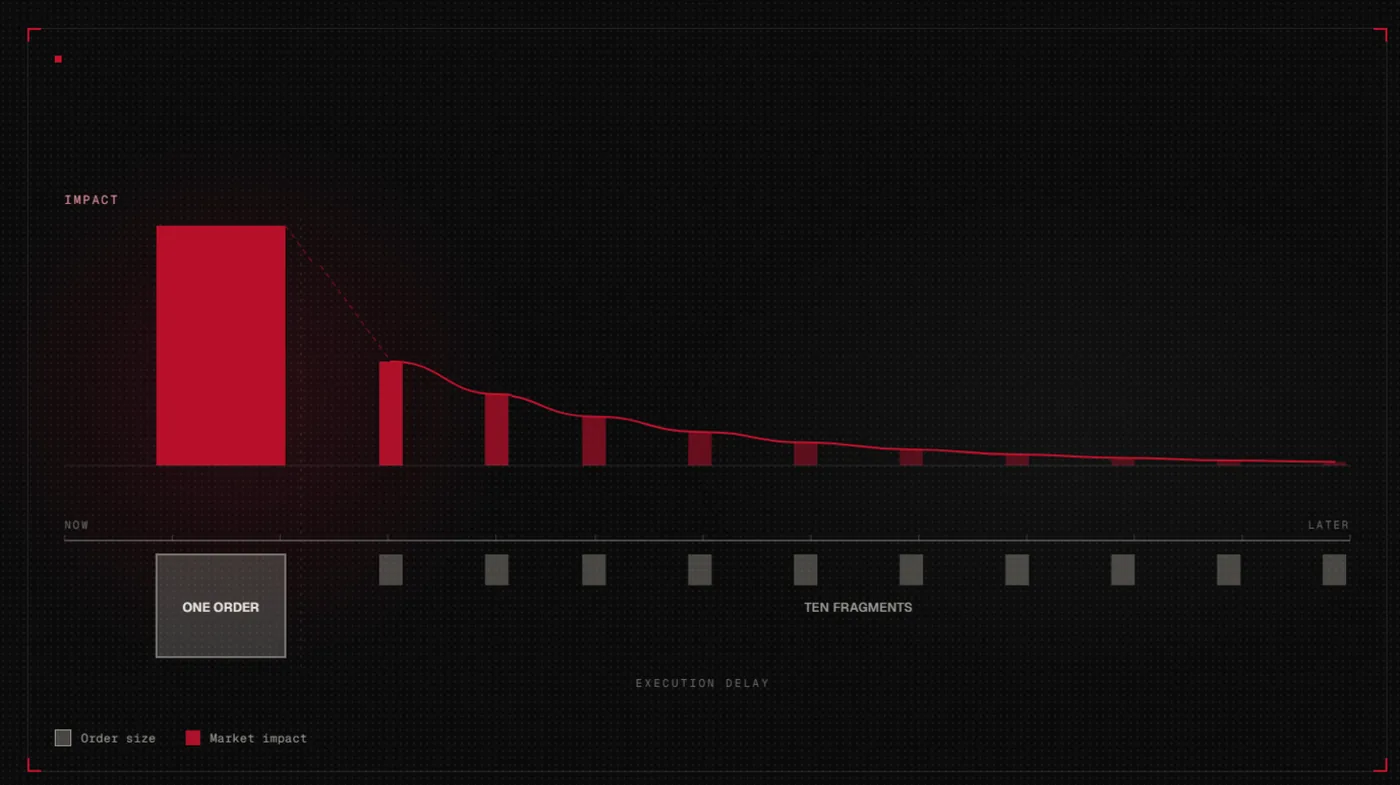
A capacity figure with no mechanism behind it is a guess, and an allocator modelling your slippage will treat it as one. A capacity figure attached to a specific technique, with a named constraint and a named lever, shows that you have thought about running institutional size in a real market.
But listen, it’s extremely easy to ruin the “Capacity” conversation quickly. Overstate your capacity and you lose the room the first time somebody models your fills themselves. Undersell it and you have capped your own business for the sake of looking conservative. My standing rule is that capacity is worth what it is worth, and I do not sell it for less. That belongs to the same discipline as saying no to money on the wrong terms.
I also asked a question back, which is the part managers skip. I assumed the $250M was where this ends up, with allocations tested at $10M, then $50M, then $100M along the way, so capacity could be re-measured as the size climbed. I assumed exclusivity would be expected at that level, and said I was comfortable with it. Both assumptions were right, and asking them made me a counterparty. A manager who only ever answers gets treated like an applicant.
What do the format requirements tell you about the buyer?
Three details came out of that conversation almost in passing. They want a PDF. They want monthly performance included in the file. And they want a separately managed account.
The PDF request means your document is going to be forwarded, opened on a phone in another timezone, and read by people you will never speak to. The monthly performance requirement means they want the distribution, so they can see the shape of the bad months and model the correlation to other products (ie. S&P, NQ, metals and so on). The SMA requirement means the money stays in the investor’s name with you trading it under a mandate, which changes the fee conversation, the operational burden from a regulatory & responsibility perspective, and quite a lot about what your business looks like.
There was one more thing I put on the table, unprompted. At that size I would employ a couple of quant colleagues into the team for continuous research and development. Institutional capital does not just underwrite a strategy, it underwrites the operation running the strategy. Naming your intended team structure before it is asked for is the same move as flagging the Sharpe: it answers a potential future objection, showing that you’re always one step ahead.
Common questions
What Sharpe ratio do institutional allocators want to see?
The screen I met was a Sharpe above 2, described to me as the bar those particular contacts apply. It varies by allocator, mandate and strategy type, and it works as a filter. Clearing it gets you a proper look; it does not get you an allocation.
Should a track record be shown gross or net of fees?
Both, labelled. Fund investors evaluate net returns and SMA investors often work from gross, so the document needs to state which figures are which and disclose the fee assumptions. An unlabelled number invites the reader to assume the least flattering interpretation, and financial promotion rules have views on this too.
How do you work out the capacity of a systematic strategy?
Capacity is the point at which slippage, market impact and financing costs erode the edge to nothing, and it is specific to your instruments, your order sizes and your execution method. Order fragmentation and execution delay are two of the levers that push the ceiling higher by reducing market impact.
Is a verified track record enough to raise institutional capital?
No, though it removes the largest single doubt. Third-party verification proves the returns are real. It does not explain the strategy, the risk framework, the capacity ceiling or the monthly distribution, and those need a document you write yourself and are willing to have forwarded without you.
Why would you tell an allocator your Sharpe ratio is going to fall?
Because they will work it out during due diligence, and it is far better coming from you. Flagging that a ratio is flattered by a short sample demonstrates that you understand your own distribution, and it makes every other figure you present more credible.
Say the awkward thing first
The whole conversation above took maybe twenty messages, and every moment that moved it forward was a moment where I said something slightly against my own interest. The Sharpe is inflated. My capacity is $100M and $250M needs more work. My deck is built off a different risk setting to my public record and I will rebuild it so they match.
None of that lost me anything. Allocators are not scanning for the manager with the cleanest story, they are looking for the person they can trust with their capital. Trust > Performance every day of the week at institutional size.
Trust > Performance every day of the week at institutional size.
If you want the wider version of this, Raising Capital covers the structural side. This piece is the part that happens in the messages.
Say the awkward thing while it is still yours to say. After that it belongs to whoever found it.
Personal commentary, not advice. Capital at risk. Past performance is not indicative of future results. Disclosure: I work for Darwinex, which offers CFDs on these instruments and a platform for systematic managers.
Disclosure. I work for Darwinex (FCA-regulated). This is my personal commentary, not advice. Capital at risk. I am an employee of Darwinex; content touching Darwinex products may represent a conflict of interest, disclosed per MAR Article 20.
XAQP figures are point-in-time as of August 2026 and will change.
Get the next letter in your inbox.
The systematic trading handbook lands in your welcome email, all 24 chapters of it.
Subscribe now