The Fifty-Million-Dollar Question
The gap between the capacity you can model and the capacity your fills will actually give you, and the month of work that closed it for me.
- My modelled capacity was $20 million to $30 million. Reading my live fills put the real number nearer $3 million, so I was overstating it by 7 to 10 times.
- Two or three strategies were capping the whole book. One traded the Sunday open on the S&P, a full round trip inside the first hour, with almost no liquidity behind it.
- I built an order splitter: 3 splits, 3 seconds apart, on entries and take profits. Stops have no delay. Metals are excluded, because at a 0.01 lot minimum a split triples the risk.
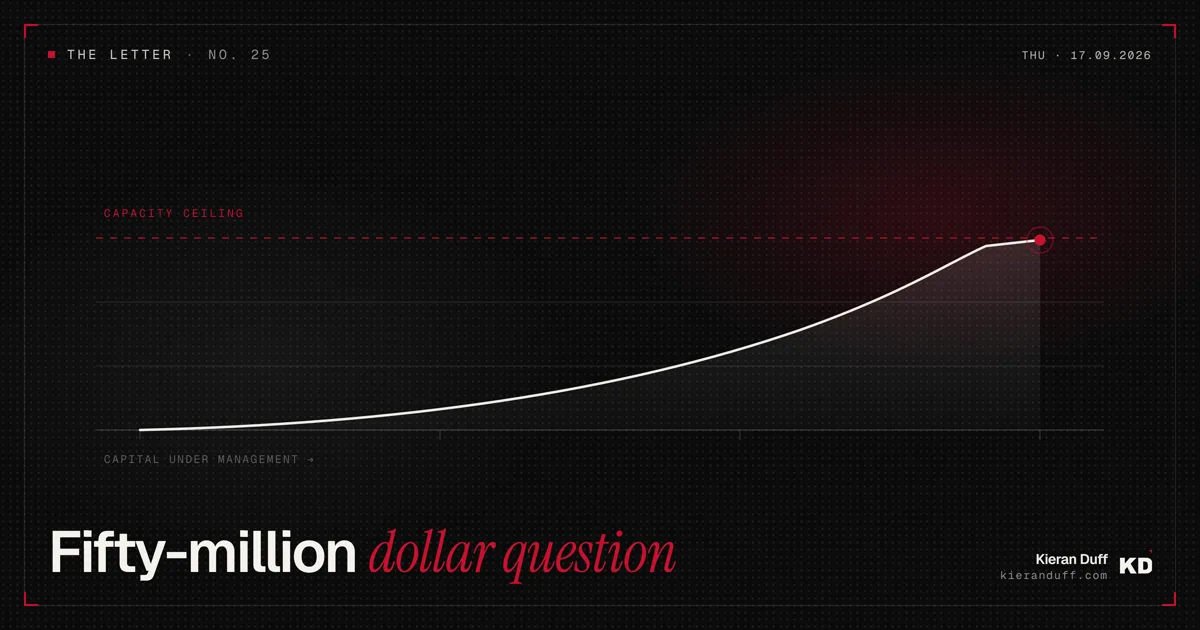
- A month of work took capacity from roughly 3 million to 100 million at the peak, now stabilised around 50 million through one broker. It cost me a few percent of return and I would take that trade every time.
The First Time I Checked My Capacity
I remember the first time looking at capacity and to me it just seemed so far away from anything that I need to ever be worried about. I think as a discretionary trader this kind of thing never really crosses your mind because you’re in your own little bubble where you’re so focused on individual mechanisms for execution. Realistically you’re not thinking about that next logical step, which is scaling.
I think mostly what keeps most traders from being successful is that they’re still trying to figure things out, meaning that they’re not always looking for that next thing. They’re not always looking to what I do in the future. Everybody says they want to scale and take more capital on but realistically I would say sub-1% actually know how much capital they can manage before they start getting absorbed by fees and edge decay.
What’s The Alpha Cap?
The first person to ask me about capacity in a professional setting was a friend of mine who I had a conversation with a couple years back. We were talking about some different strategies and taking a look at institutional investment and planning that for the future. His question to me was, “Well what’s the alpha cap? How much capacity can the system manage?” Because if the system can only manage 10 million and we start throwing 50 million at it, then we’re going to be over the edge. We’re either going to experience poor fills, extreme slippage, no alpha there at all, amongst other things.
They were brutal about this. It was very much, “Oh there’s no capacity. Okay well then there’s no allocation.” This was long before I became a systematic trader myself, building portfolios and understanding capacity on a deeper level.
Now, fast forward to XAQP. I had to start thinking about this fairly early on in my systematic journey for no other reason than I started to scale very, very quickly. I was only 8 or 9 months in before I started getting investment into my DARWIN and very quickly I hit the $1 million mark in investor capital at Darwinex. I think a month after, I then hit $2 million. It’s stabilised now, at $1.7 million but the fact is, the aggressiveness of how I was scaling (without even trying to raise capital myself or going hunting for allocators) made me look into: okay, where does this stop? If there’s really an infinite amount of capital out there looking for trading strategies and for good managers, how much capital can I take?
My Real Capacity Was Around Three Million
I started investigating my capacity and I could see that my capacity should be around $20 million to $30 million at the time, hypothetically. Then I was checking my live fills and from my actual fills my real capacity was more around $3 million. I was getting slipped hard. I was executing in non-optimal times. I was slapping too much size in the market in one go and therefore I was getting poor execution.
I only realised this because I was looking into it.
You don’t see this at face value when you’re necessarily looking at your broker statements or you’re looking at your Darwinex record or a prop account. You don’t understand any of this until you really start investigating it. My capacity, or lack thereof, came down to two separate factors.
Strategies With Low Capacity
I had a couple of strategies that, let’s say, left something to be desired when it came to their execution mechanisms. I’ve publicly spoken about one of them, which was a strategy I had designed on the S&P 500 after a conversation with a friend. They said to me, “Have you ever noticed that if the S&P closes red on a Friday, then Monday is always bullish.”
Always… That’s the word that stuck with me in that conversation.
I went away and built it. It took me all of 20 minutes to put the strategy together and it had a fantastic curve. It was a really good system and even running it live it far exceeded my expectations based on the backtest performance. It just went on an absolute tear. What it would do, in essence, is execute on the Sunday open. It would go long for a 1:1 risk-to-reward if Friday was a bearish day and usually what would happen is it would hit take profit within the hour. It was a very short-term holding position.
Now that sounds great because it was a phenomenal strategy and it did make me a decent amount of money. The big but is that you’re executing in and out of the position in illiquid hours. Your full round trip is usually within the first hour of market open on a Sunday. There is very, very little liquidity at that time. You haven’t had the London open; you haven’t had the New York open for that week so the volume is very low and you’re executing within that. You’re getting in, you’re getting out. It’s a very short holding time. It just wasn’t prime for capacity and that was dragging my whole book back because I couldn’t scale the other systems. The capital that goes in is spread amongst all of the strategies, which is a big problem.
Hitting The Book With Too Much Size
The other issue I had was hitting the book with too much size. We often hear about this from institutional investors or people talking about how institutions actually trade: they will DCA into positions and they will work an area, which is true. As a systematic trader it’s very easy to build this into your own framework.
I built a custom order splitter, which we then passed to our quant team at Darwinex. They reworked it and we pushed it out to the whole Darwinex community. This order splitter effectively works by taking your first position and dividing that position size by the amount of order splits you want to do. I usually do 3 splits with a 3-second delay and then it will trade those X amount of positions with X amount of delay.
If I’m trading 0.3 lots, for example, on EUR/USD, and the first order triggers, I will have 0.1 lots trigger. There will be a 3-second delay, then another 0.1 lots will trigger and there will be a 3-second delay. Finally the final 0.1 lots will be executed.
This also happens when the trade hits take profit. Only position 1 will have a take profit set and as soon as that registers there will be a 3-second delay. Again position 2 will execute the take profit and then there will be a 3-second delay and position 3 will close as well.
The thing is, with this on stop loss, it’s hard to add a delay because you add so much risk to your book when you do that. My stop losses don’t change. They don’t have a delay. They all have a stop set at the same place but effectively they’re all working off of the master entry position in that scenario.
The real benefit to this is that you’re splitting your size and you’re not hitting the book with enormous positions straight off the bat. I know it might sound overkill because I am only managing $2.5 million across the book as of today’s date but with leverage, that position sizing, or the notional value behind that position, is still fairly sizable. Running that through a CFD book can make the book struggle to absorb your orders. They will always be filled, usually, unless you scale too big. What happens is you’re just going to get quoted a worse price, you’re going to get slipped, you’re going to get poor fills, and you’re going to get a wide spread. All of the above.
Three Million To A Hundred Million
The real benefit of this is actually what happened after I made all of the changes that I’ve spoken about. I worked on this for about a month. I said goodbye to the strategies that were holding me back from a capacity perspective. There were only two or three and then I finally implemented the order splitter across the book. Every strategy had it.
My capacity went from roughly 3 million all the way up to 100 million at the peak. I manage it based on my previous 100 order fills so it is dynamic and it does change. Currently it’s stabilised around 50 million. That’s through one broker, one LP. If you start splitting your size across multiple brokers who use different liquidity providers, as long as there’s no cannibalisation within those, then your capacity theoretically should be higher. Even more so, generally, if you trade futures.
I Don’t Split My Orders On Metals
The only thing to note on the order splitter (and I think it’s important to say this because if anybody takes that and tries to implement it in their own portfolio or strategy) is that I don’t split my orders on metals. That forces my risk up because I trade at such low volatility on my master accounts. I can’t go any lower than a 0.01 lot size so I don’t split that. The way that the splitter would work is it would just split that three times as well and I would end up with three times the risk, which is not good. I did build into mine a mechanism to ignore metals and other assets if need be on the split so my silver and gold positions just hit the book as normal.
The Drawbacks
What’s interesting with this is that when you start working on your capacity generally you give up a little bit of performance. It’s true: it does happen. I have a lot of breakout strategies and if I’m delaying entries you might miss a certain amount of points on that trade. It can reduce your risk-to-reward, reduce your payoff, and then overall over 10 years you might give up a few percent return. There is a cost to it. It’s not free.
Unless you’re trading mean reversion, generally having an order splitter with a decent amount of delay in between the splits can work for you because you’re trying to work an area where you think it’s going to mean revert. Generally it’s really hard to pick a top or a bottom as a mean reversion trader and get it to the exact time and the exact point where it turns. Having a delay is beneficial.
50% Of Something Or 100% Of Nothing
I live my life like this: I would rather have 50% of something than 100% of nothing. That’s the way I see it when I make these changes and make these enhancements to my book: yes you may give up a small bit of performance. If it means that you can scale to 100 times the size, then I would rather have 50% of 100 million than 100% of 1 million. It has to always be about scale.
Where am I going to grow more? What is going to allow me to grow more? What sort of infrastructure is going to get me into the conversations with the larger allocators and the people that I want to scale to be like?
The next thing for me is to focus on scaling my capital to at least 10 million+. I think as I reach 10 million I will likely increase my order splits further and see how that increases my capacity on my CFD book.
At that point it’s likely that I’ll start porting things over to futures as well, to be able to offer futures exposure. That way, for the larger allocations that come from the institutional guys who generally prefer futures over CFDs, I’ll be able to cater to them with much higher capacity.
Capacity Isn’t A Problem Until It’s A Problem
I hope you find some value in this and take something away for your own book, because I’ve always said this: capacity isn’t a problem until it’s a problem and you don’t want it to become a problem. Please take some time and run some diagnostics on your own book and see if there’s any low-hanging fruit that you can improve on. The last place you want to be is sat in front of an allocator who wants to give you money to trade with and you cannot take that capital on.
Common questions
What is capacity in systematic trading?
Capacity is the amount of capital a strategy or a book can take before the returns start getting eaten by execution costs. It is set by liquidity in the instruments you trade, the hours you trade them, how much size you put in the book at once, and how long you hold. Past that ceiling you get quoted worse prices, wider spreads and heavier slippage, and the edge decays.
Why is modelled capacity higher than real capacity?
Because the model runs on volume and spread assumptions while your fills run on what the book actually gave you. My modelled capacity was around $20 million to $30 million. Reading my live fills put it nearer $3 million, a gap of 7 to 10 times, and the difference was slippage, executing in illiquid hours, and hitting the book with too much size in one go.
How does an order splitter increase capacity?
It divides your position into smaller child orders with a delay between each one, so the book absorbs your size in pieces instead of all at once. I usually run 3 splits with a 3-second delay, on entries and on take profits. Stops have no delay and all sit at the same price, because delaying a stop adds real risk to the book. One caveat: I do not split metals, because at a 0.01 lot minimum a three-way split would triple my risk instead of dividing it.
Does improving capacity cost you performance?
Yes. Delaying entries on breakout strategies means missing points, which reduces the payoff and the risk-to-reward, and over ten years that can come to a few percent of return. I take that trade because it buys scale: I would rather have 50% of 100 million than 100% of 1 million. Mean reversion strategies often gain from the delay, since working an area beats trying to pick the exact turn.
Personal commentary, not advice. Capital at risk. I work for Darwinex (FCA-regulated) and this is my own opinion.
Disclosure. I work for Darwinex (FCA-regulated). This is my personal commentary, not advice. Capital at risk. I am an employee of Darwinex; content touching Darwinex products may represent a conflict of interest, disclosed per MAR Article 20.
Capacity figures are estimates derived from my own fill history at one broker and one liquidity provider. They are specific to my book and are not a promise of what any strategy can absorb.
Past performance is not indicative of future results.
Get the next letter in your inbox.
Free to subscribe to the Letter, and you’ll get the next one in your inbox.
Subscribe now