Leave It Alone
The psychology doesn’t disappear when you systematise your trading. It moves. All the discipline lives in the rules and all the discomfort lives in you.
- Systematising relocates the emotion. The decisions get quarantined in the rules; the feelings stay with you, and they concentrate.
- Your job as a systematic trader is mostly to not act. That is a far harder discipline than acting, and almost none of the trading-psychology literature is written for it.
- Willpower is the wrong tool. Build friction into the architecture so that overriding is difficult and slow, and the decision gets made while you are calm, before the hurt arrives.
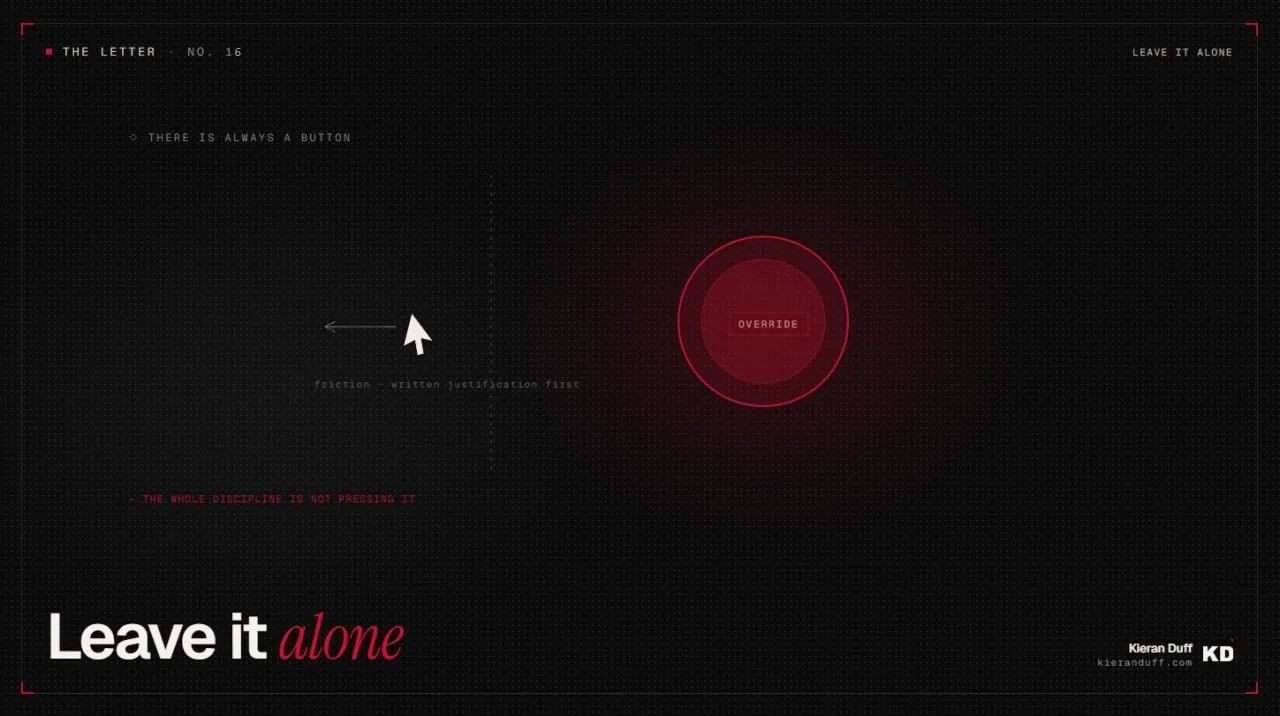
The comforting story about systematic trading is that it removes the psychology. The algorithm carries the load, the decisions are made in advance, and you sit back and watch the money flow.
I traded discretionary for seven years before going systematic, and I can tell you that it’s not as easy as you think.
The system executes the same in a drawdown as it does on a record day. It feels nothing. It second-guesses nothing. It does not refresh the equity curve at eleven at night to see how bad the damage looks. That job is still yours. All of the discipline lives in the rules, and all of the discomfort lives in you.
Why does a systematic trader still need psychology?
Because somebody has to leave the rules alone when it hurts, and that somebody is you.
Every trading-psychology book on the shelf is written for a discretionary trader. Fear and greed, revenge trading, cutting winners early and letting losers run, hesitating on entries. All of that is real and none of it is your problem any more, because you have already handed those decisions to a machine that does not have feelings about them.
What you have instead is one brutal discipline: leaving the thing alone when it is uncomfortable to watch. That is the entire game. And it is harder than it sounds, because the market will spend months at a time inviting you to intervene, and every intervention will feel like “responsibility” while you are making it.
The system only quarantines your worst decisions. There is always a button.
Where do you feel the discomfort?
It lands in the sitting still.
When a drawdown arrives (and they always arrive), there is nothing for me to do. I cannot trade my way out to make the chart look better, because the entire value of the thing is that I do not interfere with it. I cannot tighten a stop to soothe my own anxiety, or skip a trade because the timing feels wrong this once. The moment I start overriding the system to manage how the equity curve looks, I am running my feelings with capital attached.
So the only job left during a drawdown is the hardest one. Hold your nerve. Let the process do what the data said it would, while it is unpleasant to watch.
This is a genuinely strange psychological position, and it is why systematic traders often struggle in ways that surprise them. You have engineered a role for yourself in which the correct action, almost always, is no action. Then you have to perform that role for months, in the face of a screen that is actively arguing with you.
What does the interference look like?
It’s never a dramatic interference, it’s usually just something small and minor.
It looks like skipping one trade because the news feels wrong today. Cutting size by half, temporarily, just while things settle down. Turning off the strategy that has been ugly lately and leaving on the ones that have been kind, which is equity-curve trading by another name, and it reliably gives back more than it saves: you eat the drawdown and then sit out the recovery.
Re-optimising the parameters mid-drawdown is the sneakiest one, because it refits the system to the noise of the bad period.
Every one of these feels like risk management whilst you’re in the moment. That feeling is a trap. And the reason they are so seductive is that they occasionally work, which is the worst possible outcome, because it teaches you to do it again.
Why is a live drawdown harder than the backtest suggested?
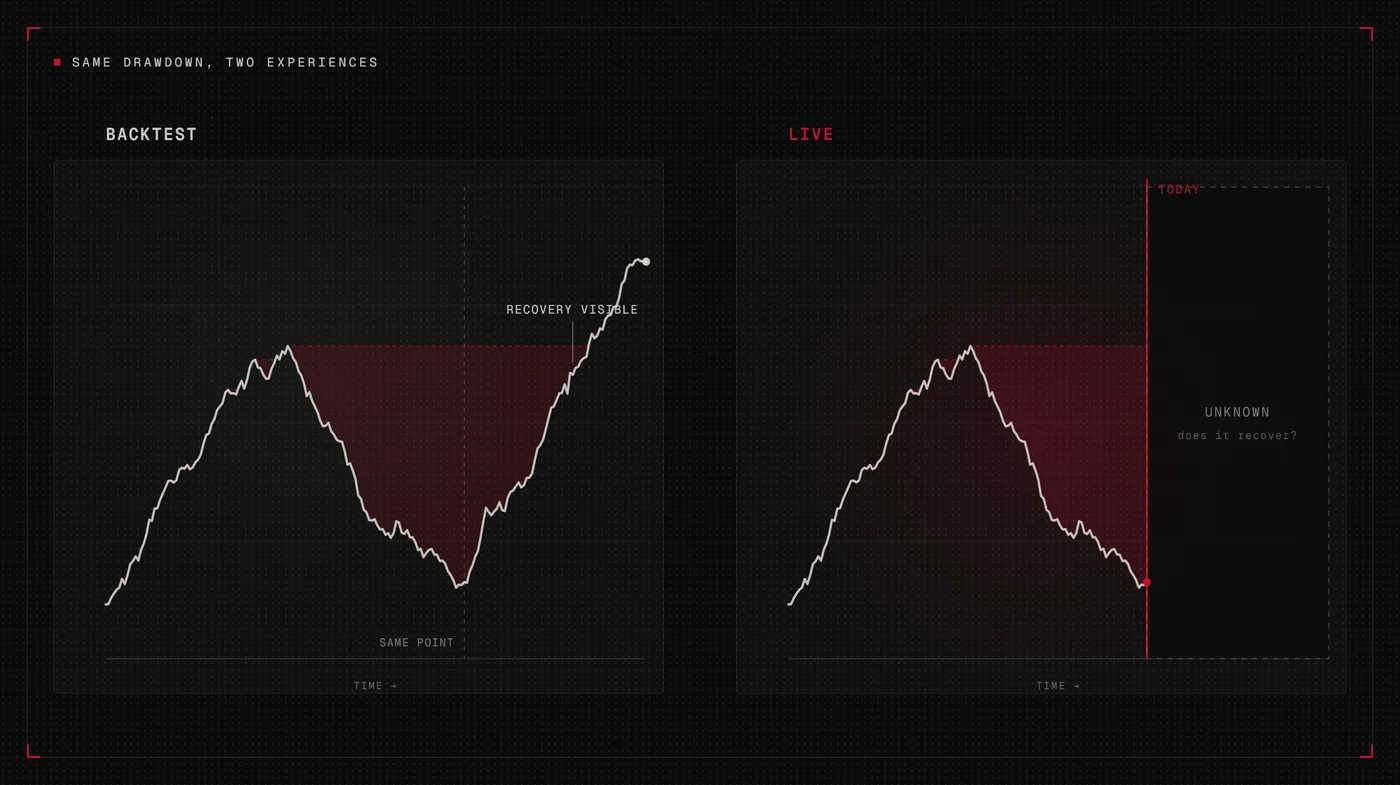
Because in the backtest, you can already see the recovery.
This is the single most under-appreciated fact in systematic trading. When you look at a historical drawdown on your equity curve, the chart continues to the right. You know, with total certainty, that it comes back, because you are looking at the part where it came back. You scroll past it in a second and think, that looks survivable.
Live, the chart stops at today. The right-hand side is blank. The drawdown you are in looks exactly like the ones that recovered and exactly like the ones that never did, because at this point in the data those two things are indistinguishable. The absence of that future knowledge is most of the pain, and it is why traders who have studied their own drawdown history in detail still panic inside it.
Same chart, very different seat.
How do you make not interfering the default?
Stop relying on willpower, because willpower is the first thing stress removes.
Build the architecture instead.
Decide what normal looks like in advance. Resample your own trade sequence (shuffle and redraw your historical trades a few thousand times, Monte Carlo style), get the distribution of outcomes your strategy can plausibly produce, and write down the band. Anywhere inside that envelope is the strategy behaving, however grim it feels. My own sims tell me XAQP’s max drawdown has scope to stretch to 9-10% (and may well even further through extreme conditions, plus a reshuffled sequence), well past the worst I have actually sat through, and knowing that number is what lets me sit through the smaller ones without flinching. That single band, decided while you are calm, converts an emotional question into a factual one.
Write the kill rules before you go live. Actual conditions, in writing, with thresholds drawn from the backtest’s own distributions, so there is no arguing with yourself later about what broken means. When the rule fires, the strategy comes off the book for good. A pause just leaves the door open for the override.
Size so that no single strategy can tempt you. This is the underrated one. If a strategy is sized small enough that its worst drawdown costs the book something you can shrug at, you will not agonise over it. Conviction becomes unnecessary, which is the point. It is exactly why every sub-strategy in XAQP is built to a maximum historical drawdown of -1% at strategy level: any one of them can die without taking my nerve with it. A strategy that represents a large slice of your risk can never be killed cleanly, because by the time it is clearly broken you are too deep in it to be objective.
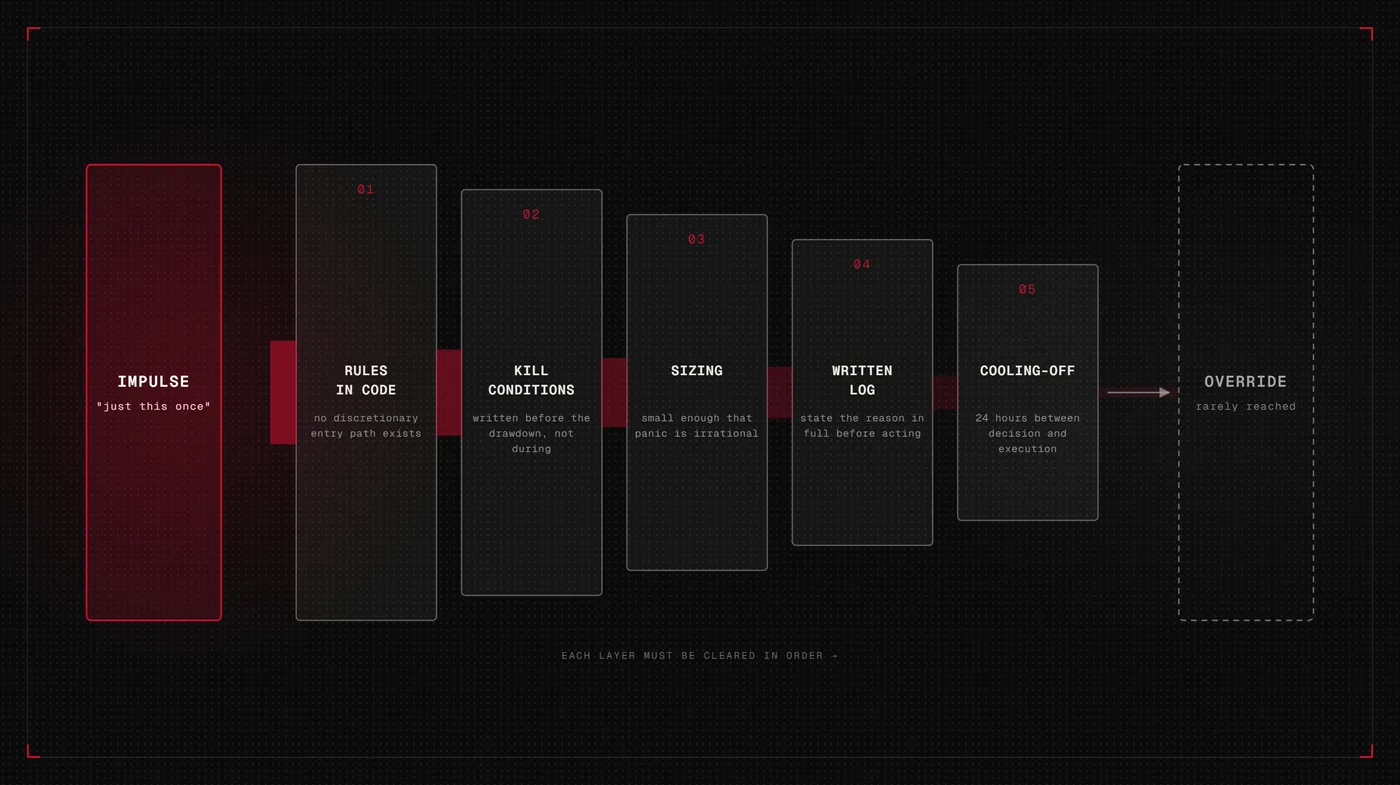
Put friction between the impulse and the button. Require yourself to write down, in a log, the specific evidence that justifies any manual intervention, before you make it. Most impulses do not survive being written down.
What about doing this in public?
It raises the stakes considerably and it is worth being honest about that.
When your track record is public and verifiable, a drawdown is something other people can watch you sit through in real time. Colleagues. Allocators. People who understand exactly what they are looking at. The temptation to intervene, purely to make the curve presentable, becomes a real force.
And the intervention would be the worst possible thing you could do, because the entire value of a verified record is that it shows what the system does. Start massaging it and the record stops meaning anything.
I will be honest: public scrutiny has not made me a better trader, and if anything the pressure pushes the other way. What it tests is the one thing no backtest can measure: whether you can keep your hands off the wheel while the rules do their work.
What actually helps?
Concrete things. Affirmations do nothing here.
Look at the leading indicators instead of the P&L. If you have wired up live-versus-backtest variance, the shape of the edge, and fill quality, you have something factual to examine when you feel the urge to act. Examining data is a legitimate outlet for the impulse to do something. It gives the urge somewhere safe to go.
Check the thesis instead of the returns. Ask whether the market behaviour your strategy captures is still occurring.
Reduce your screen contact. There is no operational reason to watch a systematic book intraday. The system does not need you, and every hour you spend watching it is an hour of accumulating an urge to intervene.
And get comfortable with the fact that some of your best months will be the quiet ones, where nothing fires and you do nothing at all. The activity that feels like work is usually the activity that costs you.
Some of your best months will be the quiet ones, where nothing fires and you do nothing at all.
Common questions
Does systematic trading remove the emotion?
No, it relocates it. The system removes emotion from the decisions by putting them in rules. The discomfort of watching a drawdown play out does not go anywhere, and it tends to concentrate, because you have deliberately denied yourself the option of intervening to feel better.
How do I stop myself overriding my system?
Make overriding difficult and slow. Pre-commit the rules in code, write the kill conditions before going live, size small enough that no single strategy tempts you, and require a written justification before any manual intervention.
How do I know if a drawdown is normal?
Define the variance band before you go live, from a resampled distribution of your own trade sequence. Anywhere inside the envelope counts as the strategy behaving, however unpleasant it feels. Make that call while you are calm, because you will not make it fairly once the money is moving.
Is it ever right to intervene?
Yes, on pre-defined conditions. A kill rule that fires on evidence is a decision you already made. Switching something off just because the drawdown hurts is a discretionary trade, whatever you tell yourself.
Personal commentary, not advice. Capital at risk.
Disclosure. I work for Darwinex (FCA-regulated). This is my personal commentary, not advice. Capital at risk. I am an employee of Darwinex; content touching Darwinex products may represent a conflict of interest, disclosed per MAR Article 20.
XAQP figures are point-in-time as of August 2026 and will change.
Get the next letter in your inbox.
The systematic trading handbook lands in your welcome email, all 24 chapters of it.
Subscribe now